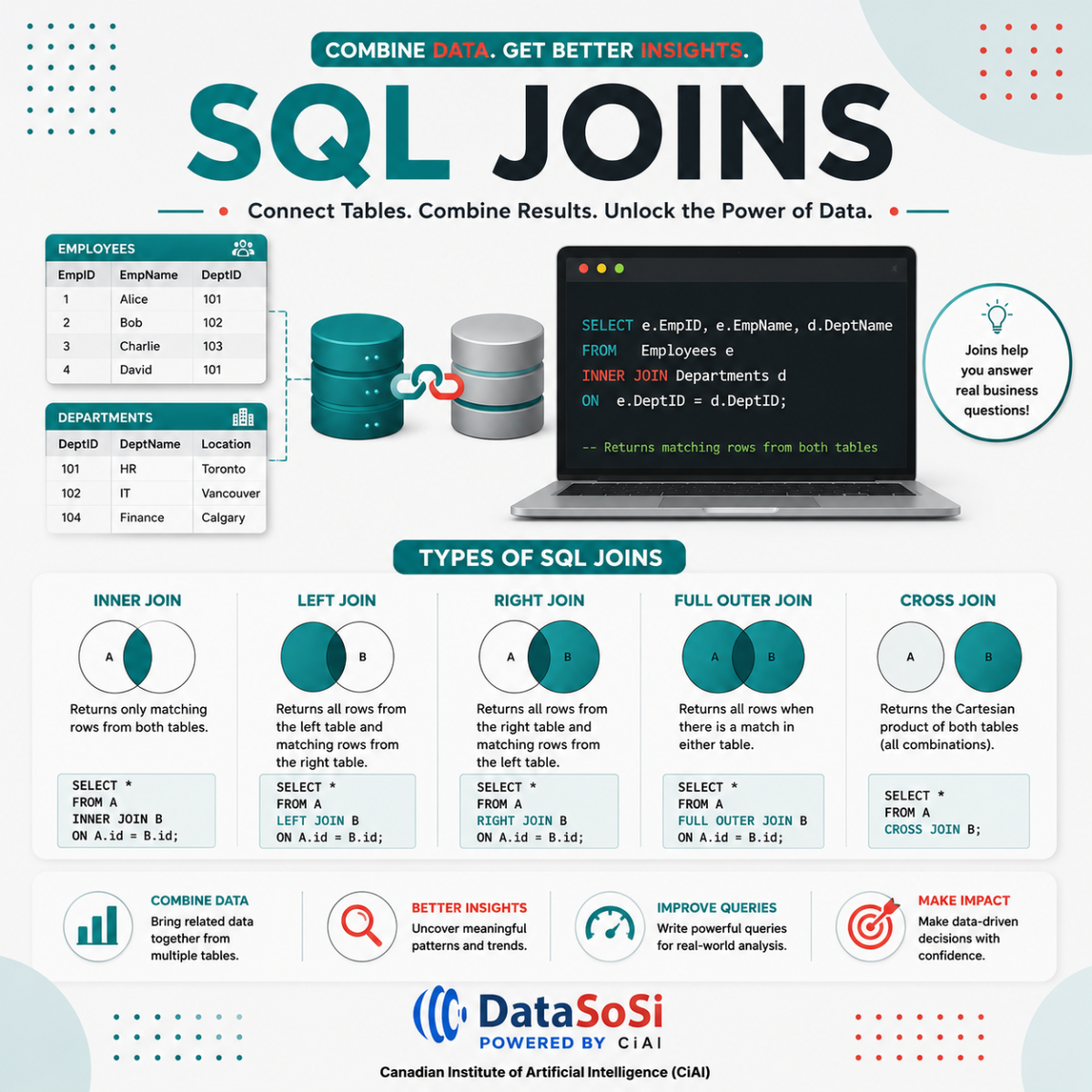
SQL Joins
Learn how analysts connect customers, orders, and payments to build reports, detect missing data, and reconcile business systems.
5 focused topics · 3 capstone projects · AI-assisted editor · AI Tutor · Certificate included.
Connect Real Business Tables
Work with a realistic customers → orders → payments schema instead of isolated syntax drills.
Find Missing & Broken Relationships
Use LEFT/RIGHT JOIN, NULL checks and CASE to surface missing payments, inactive customers and orphan records.
Build Reporting-Ready SQL
Combine multi-table joins with SUM, COUNT, AVG and MAX to create business metrics and dashboard-ready outputs.
3 Applied Capstones
Complete Core Joins, Reconciliation & Multi-Table Joins, and Joins + Aggregation capstones.
SQL Joins Turns Separate Tables into Business Answers
Real organizations rarely keep everything in one table. Customer details, orders, payments, transactions and operational activity are stored separately. The analyst's job is to connect them correctly — without losing records, duplicating rows, or hiding data-quality problems.
Why this skill matters
A correct JOIN can answer questions that no single table can answer: Who bought what? Which orders were paid? Which customers have no activity? Which payment does not belong to a valid order? How much did each customer spend? These are the kinds of questions behind reporting, reconciliation, auditing, and business intelligence.
Skills you'll gain
- Choose INNER, LEFT or RIGHT JOIN based on the business question
- Connect customers to orders using customer_id
- Connect orders to payments using order_id
- Use IS NULL to identify missing relationships
- Use CASE to create readable audit statuses
- Chain three tables for complete transaction views
- Combine JOINs with GROUP BY, SUM, COUNT, AVG and MAX
Workplace problems you'll practise
- Customers who have never placed an order
- Orders with no matching payment
- Payments that reference an order that does not exist
- Customer purchase and payment histories
- Total spending by customer
- Revenue and payment analysis by city
- Reporting-ready customer, order and payment summaries
Who should take this course
- Learners who understand basic SELECT and WHERE and want to master relational analysis
- Data analyst and BI learners who need stronger multi-table SQL skills
- Business professionals working with data from multiple systems
- Learners preparing for reporting, audit, reconciliation or analytics work
Prerequisites
- SQL Basics or equivalent foundational SQL is recommended
- Comfort reading simple SELECT and WHERE queries will help
- No AI-tool experience is required
SQL Joins Curriculum: 5 Practical Topics
The course progresses from matching records, to preserving missing records, to reconciliation, and finally to multi-table business reporting.
Connect rows that exist in both tables and build confirmed customer-order-payment relationships.
- The INNER JOIN pattern and ON clause
- Customers + orders
- Orders + payments
- Three-table INNER JOIN
- JOIN + WHERE
- JOIN + GROUP BY foundations
Preserve the full primary population and expose rows where the related record is missing.
- All customers and any orders
- All orders and any payments
- Customers with no orders
- Orders with no payments
- Counting activity including zero
Understand join symmetry and preserve the right-hand population when that is what must be audited.
- All payments and matching orders
- Orphan payment detection
- Payments with order status
- Payments with order date
- Payments with customer name when available
Use joins, NULL logic and CASE to validate relationships before trusting a report.
- Orders without payments
- Payments without orders
- Customers with no orders
- Paid vs No Payment labels
- Valid Order vs No Order labels
- MySQL reconciliation patterns without native FULL JOIN
Connect all three tables, then summarize the joined result into metrics decision-makers can use.
- Customers, orders and payments in one query
- Total spending per customer
- Number of orders per customer
- Average payment by city
- Total revenue by order status
- Most recent payment date
- SUM, COUNT, AVG, MIN and MAX after JOIN
3 Hands-On SQL Joins Capstone Projects
The course has exactly three capstones, progressing from join selection to data-quality reasoning and business reporting.
Core Joins: INNER vs LEFT vs RIGHT
Choose the correct join for different business populations, connect the proper keys, and explain why rows appear or disappear.
- INNER JOIN
- LEFT JOIN
- RIGHT JOIN
- Correct join keys
Reconciliation & Multi-Table Joins
Audit the customers → orders → payments chain, surface missing relationships, preserve orphan records, and build readable validation views.
- LEFT JOIN + IS NULL
- Three-table joins
- CASE audit labels
- Data reconciliation
Joins + Aggregation
Turn joined transaction data into customer totals, order counts, payment summaries and reporting-ready grouped results.
- GROUP BY after JOIN
- SUM & COUNT
- AVG & MAX
- Business reporting
See Inside a Real SQL Joins Lesson
The course teaches JOIN choice through the business question, not by memorizing diagrams alone.
Business question: Which orders have no matching payment?
An INNER JOIN would hide the problem because it keeps only matched rows. To audit every order, preserve orders with a LEFT JOIN and then look for a missing payment key.
The key skill is deciding what must remain visible before writing the JOIN. That same reasoning carries into reconciliation, auditing, dashboards and multi-table analytics.
SQL Joins Course Details
Frequently Asked Questions
You will learn INNER JOIN, LEFT JOIN, RIGHT JOIN, missing-match detection, data reconciliation, multi-table joins, and joins with aggregation for reporting.
The SQL Joins course includes exactly 3 capstone projects: 1) Core Joins: INNER vs LEFT vs RIGHT, 2) Reconciliation & Multi-Table Joins, and 3) Joins + Aggregation.
The course uses customers, orders, and payments. customers connects to orders through customer_id, and orders connects to payments through order_id.
Yes. A major focus is using LEFT JOIN or RIGHT JOIN with NULL logic to find missing payments, customers with no orders, and orphan payment records.
MySQL does not support a native FULL OUTER JOIN keyword. This course focuses on practical reconciliation using LEFT JOIN, RIGHT JOIN, NULL filtering and CASE. UNION-based full-outer workarounds are more advanced.
SQL Basics or equivalent foundational SQL is recommended. You should be comfortable reading simple SELECT and WHERE queries.
Yes. Learners who complete the course receive a certificate of completion from the Canadian Institute of Artificial Intelligence (CiAI).
For current policy details, visit the DataSoSi FAQ page or Contact Us.
Continue Building Your SQL Skills
After SQL Joins, continue with courses that strengthen analytical SQL, advanced query logic, reporting, and AI-assisted workflows.
Meet the Creator of the Course
Learn from an educator who works across data science, machine learning, AI, analytics, and applied business problems.

Dr. Mark Lokanan
Professor · Senior Machine Learning Engineer · Data Scientist · AI Specialist
Dr. Mark Lokanan is a professor at Royal Roads University and a Senior Machine Learning Engineer at Vedia. His work spans data science, machine learning, artificial intelligence, analytics, financial crime, and applied research. Drawing on both academic and industry experience, he designed the SQL Joins course to help learners understand how relational data connects in real business systems and how analysts use joins for reporting, reconciliation, auditing, data quality, and business intelligence.

