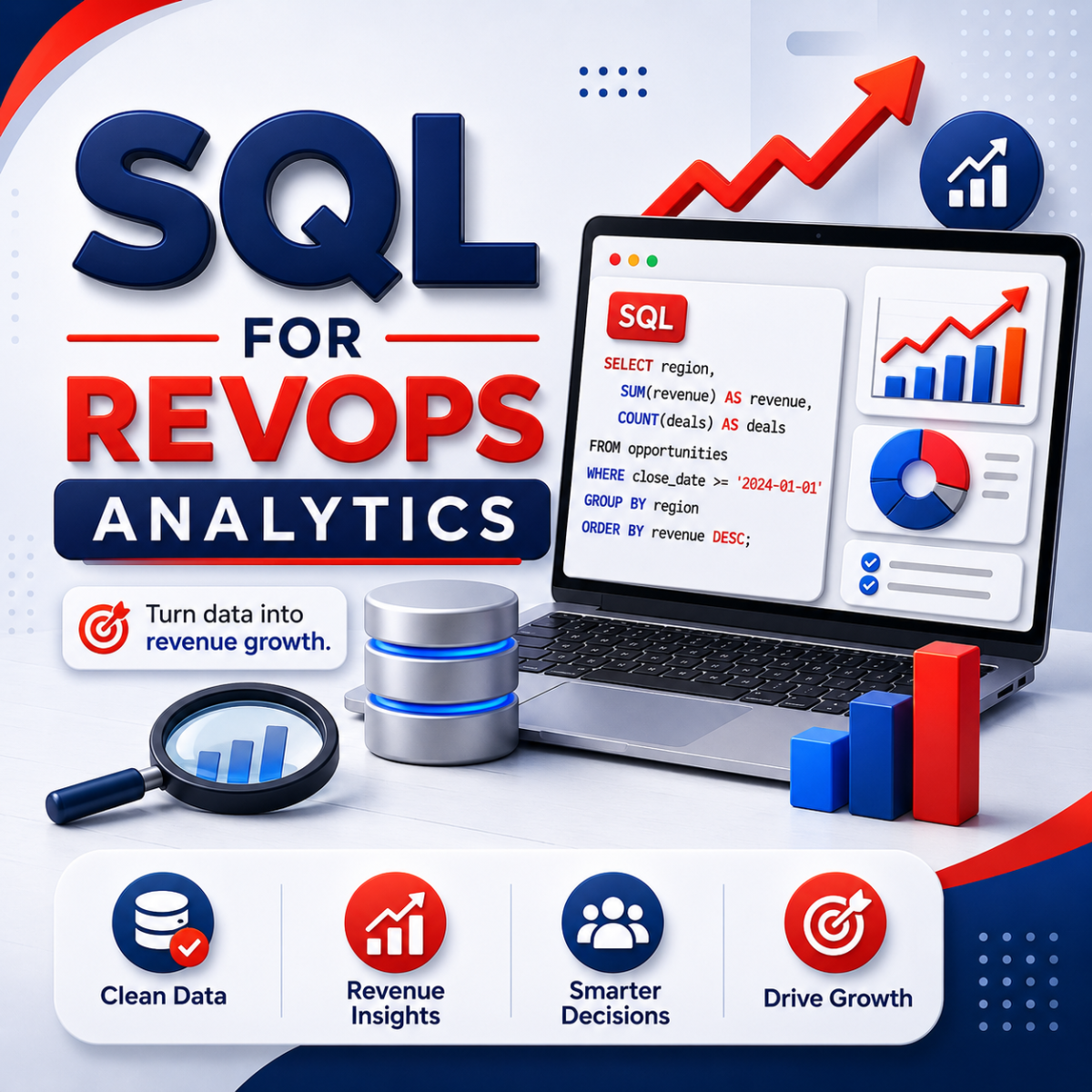
SQL Rev Ops
Use SQL to analyze the complete revenue lifecycle—from lead generation to closed deals, subscriptions, renewals and churn.
3 course parts · 18 applied topics · 3 capstone projects · AI Tutor · Certificate issued by CiAI.
Self-paced online · Designed for learners who have completed SQL Basics and SQL Beginner, or have equivalent foundational SQL skills.
Analyze the Full Revenue Funnel
Connect marketing, sales and customer success data to understand how revenue is created, converted and retained.
Measure Pipeline & Forecast Revenue
Analyze pipeline value, weighted forecasts, win rates, sales performance and expected revenue.
Turn CRM Data into Strategy
Evaluate attribution, CAC, engagement, cohorts, CLV, churn, retention and sales velocity.
3 Applied Capstone Projects
Complete one capstone after each part: foundations reporting, pipeline analytics and executive revenue intelligence.
Use SQL to Understand How Revenue Really Moves Through a Business
Revenue Operations brings marketing, sales, and customer success into one connected revenue system. This course teaches learners how to use SQL to understand that system—from the first lead entering a campaign to an opportunity closing, a subscription becoming active, and a renewal being won or lost.
Why take SQL RevOps after SQL Basics and SQL Beginner?
SQL Basics and SQL Beginner teach you how to retrieve, filter, group, and combine data. SQL RevOps applies those skills to real commercial questions: Which campaigns create pipeline? Which reps convert revenue? Where are deals slowing down? How much recurring revenue is at risk? Which customers are most valuable?
What you will learn
- Understand how RevOps data flows across marketing, sales and customer success
- Analyze leads, campaigns, accounts, contacts and revenue structure
- Measure lead-to-opportunity conversion and funnel drop-off
- Calculate pipeline value and weighted pipeline forecasts
- Compare sales rep performance, win rates and deal outcomes
- Evaluate marketing attribution and campaign revenue contribution
- Analyze sales activity and engagement patterns
- Perform cohort analysis and estimate customer lifetime value
- Identify churn risk and measure retention
- Measure sales velocity and pipeline bottlenecks
- Build executive revenue KPIs such as MRR, pipeline and closed revenue
Who this course is for
- Marketing, sales and customer success professionals
- Revenue Operations and CRM analysts
- Business and management learners who want practical SQL skills
- Data analysts working with customer, pipeline or subscription data
- Non-technical professionals moving into analytics-focused roles
SQL RevOps Curriculum: 3 Parts Across the Revenue Lifecycle
The course progresses from understanding revenue data, to pipeline and conversion analysis, to executive-level revenue intelligence and strategy.
Build SQL confidence using realistic CRM, marketing and account data while learning how the revenue system fits together.
- Introduction to RevOps and SQL
- Leads and campaign data
- Accounts, contacts and revenue structure
- Filtering revenue data with WHERE
- Aggregating metrics with COUNT, SUM and AVG
- Basic RevOps reporting
- Capstone 1: Revenue Foundations Performance Report
Answer the operational questions Revenue Operations teams use to manage pipeline, marketing contribution and sales execution.
- Lead-to-opportunity conversion analysis
- Pipeline analysis
- Sales performance analysis
- Marketing attribution and ROI
- Activity and engagement analysis
- Revenue forecasting basics
- Capstone 2: Pipeline Conversion & Revenue Forecast
Move from operational reporting into strategic analysis of revenue growth, customer value, retention and executive performance.
- End-to-end funnel analysis
- Cohort analysis
- Customer Lifetime Value (CLV)
- Churn and retention analysis
- Sales velocity and bottleneck detection
- Executive dashboards and KPIs
- Capstone 3: Executive Revenue Intelligence Dashboard
See the Revenue Lifecycle End to End
Example: Calculate weighted pipeline value
Revenue teams rarely treat every open opportunity as equally likely to close. A weighted forecast multiplies each opportunity amount by its probability so leaders can estimate expected pipeline value.
This is the kind of SQL that turns CRM data into an operational decision tool rather than a static report.
3 Hands-On SQL RevOps Capstone Projects
The course includes exactly 3 capstone projects — one after each course part — so learners apply SQL to increasingly strategic Revenue Operations problems.
Revenue Foundations Performance Report
Build a foundational RevOps report combining lead, campaign, account and opportunity metrics to show how revenue data is organized and summarized.
Skills: filtering, aggregation, campaign summaries, account metrics.
Pipeline Conversion & Revenue Forecast
Analyze lead conversion, pipeline by stage, sales performance, marketing attribution and probability-weighted expected revenue.
Skills: conversion rates, pipeline analysis, attribution, forecasting.
Executive Revenue Intelligence Dashboard
Create an executive-level SQL summary covering funnel performance, cohort trends, CLV, churn risk, sales velocity, MRR and strategic revenue KPIs.
Skills: cohort analysis, CLV, retention, velocity, executive KPIs.
Recommended SQL Learning Path After This Course
Assuming you have completed SQL Basics and SQL Beginner, the following courses are recommended after SQL RevOps to strengthen your SQL depth and expand into more advanced analytics.
SQL Intermediate
Build stronger query logic with subqueries, CTEs, advanced filtering and data cleaning.
Explore SQL Intermediate →SQL Advance
Move into performance, advanced set logic, window functions, recursive CTEs and executive reporting.
Explore SQL Advance →SQL AI-Assisted
Learn to generate, inspect, debug and verify SQL with AI while keeping human judgment in control.
Explore SQL AI-Assisted →SQL Data Analytics
Broaden into BI, data engineering and machine-learning preparation with applied analytical SQL.
Explore SQL Data Analytics →Course Details
Frequently Asked Questions
The course is designed for marketing, sales and customer success professionals, RevOps and CRM analysts, business learners and non-technical professionals who already have foundational SQL skills.
The course includes exactly 3 capstone projects: 1) Revenue Foundations Performance Report, 2) Pipeline Conversion & Revenue Forecast, and 3) Executive Revenue Intelligence Dashboard.
The certificate of completion is issued by the Canadian Institute of Artificial Intelligence (CiAI).
Part 1 covers RevOps foundations: leads and campaigns, accounts and contacts, WHERE filtering, aggregations and basic revenue reporting.
Part 2 covers lead-to-opportunity conversion, pipeline analysis, sales performance, marketing attribution, engagement analysis and revenue forecasting.
Part 3 covers end-to-end funnel analysis, cohorts, customer lifetime value, churn and retention, sales velocity, bottlenecks and executive KPIs.
The course covers lead conversion rate, pipeline value, win rate, sales velocity, customer acquisition cost, customer lifetime value, churn, monthly recurring revenue and revenue growth.
Assuming you completed SQL Basics and SQL Beginner, recommended next courses are SQL Intermediate, SQL Advance, SQL AI-Assisted and SQL Data Analytics.
For current subscription, cancellation, and refund information, visit the DataSoSi FAQ page or Contact Us.
Meet the Creator of the Course
Learn from an educator and machine learning engineer working across analytics, AI, data science and applied business problems.

Dr. Mark Lokanan
Professor · Senior Machine Learning Engineer · Data Scientist · AI Specialist
Dr. Mark Lokanan is a professor at Royal Roads University and a Senior Machine Learning Engineer at Vedia. His work spans data science, machine learning, artificial intelligence, analytics, financial crime, and applied research. Drawing on both academic and industry experience, he designed SQL for Revenue Operations Analytics to help learners connect SQL with real commercial decision-making across marketing, sales, customer success, pipeline management, forecasting, retention, and revenue intelligence.