

Currently Empty: USD$0.00
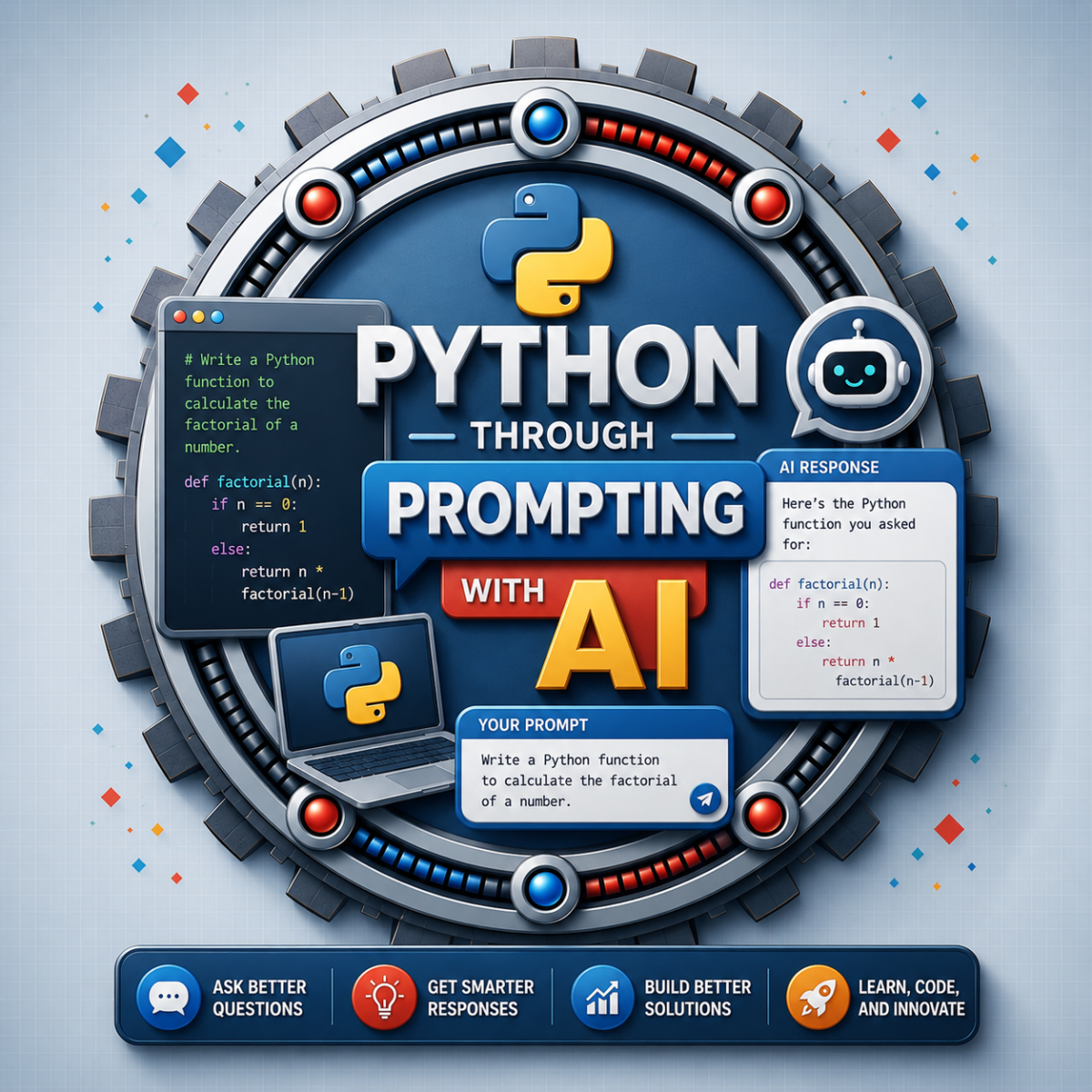
⭐ Featured
Python AI Prompting
Learn Python by directing AI — then understand, debug, refine, and verify the code it generates.
10 individual projects · 1 final 15-task capstone · hands-on prompting workflow · AI Tutor · CiAI certificate.
Original price was: USD$50.00.USD$15.99Current price is: USD$15.99. /month
Self-paced online · Python for Working Professionals or equivalent Python foundation recommended.
Complete enrollment through DataSoSi checkout. Payment options depend on checkout configuration.
Prompt AI with Purpose
Learn how to tell AI exactly what Python task to perform, what output you expect, how simple the code should be, and what constraints it must follow.
Understand the Code
Do more than copy generated Python. Ask AI to explain code at your level and connect syntax, variables, data structures, decisions, loops, and functions to the task.
Debug and Verify
Use structured Debug prompts, inspect errors, refine the request, run the code, and check that the output actually matches the requirement.
Build 10 Projects + Final Capstone
Complete one hands-on project for each unit, then finish with a 15-task capstone integrating the full prompting-to-verification workflow.
What You’ll Learn in Python AI Prompting
Python AI Prompting is the first course in DataSoSi's Python for Adult Work Transition pathway. It combines three progressive stages—Introduction, Intermediate and Advanced—so learners can begin with the language itself and continue into object-oriented programming, concurrency, APIs, professional data analysis, visualization and automation.
Designed for adults changing careers or adding technical skills
Part 1 begins with no prerequisite programming knowledge. Concepts use relatable professional examples such as text cleaning, calculations, records, approvals, routing, files, reports and reusable utilities. The pathway then builds toward Python patterns used in data, AI, automation and modern workplace systems.
Introductionsyntax · data · logic · functions · files
IntermediateOOP · inheritance · generators · decorators
Scale Your Codethreading · multiprocessing · efficient processing
Advanced ApplicationAPIs · Pandas · NumPy · visualization · automation
What you will learn
- Write Python scripts using variables, data types, strings and numbers
- Use lists, dictionaries, sets and tuples
- Automate decisions and repetitive tasks with conditions and loops
- Build reusable functions and work with modules and packages
- Read and write workplace files and handle errors safely
- Build object-oriented systems with classes and inheritance
- Use iterators, generators, comprehensions and decorators
- Understand threading and multiprocessing
- Work with APIs and JSON data
- Build file-processing and data-pipeline workflows
- Analyze data with Pandas and NumPy
- Create business visualizations with Matplotlib and Seaborn
- Automate repetitive workplace tasks with Python
Who this pathway is for
- Adults moving into a new career
- Professionals who want practical coding skills
- Non-technical learners entering data, analytics, AI or automation
- Business and social-science professionals who want to work confidently with Python
- Learners preparing for specialized Python, data science or AI courses
10 Individual Python AI Prompting Projects
Each unit ends in a hands-on project. Learners practice the same core cycle: write the prompt, generate code, understand it, refine or debug it, run it, and verify the output.
Direct AI to generate simple Python, refine a request, understand the code it produces, and fix basic syntax problems.
Practice Generate, Explain, Modify, and Debug prompts so AI produces code that matches the task, output, skill level, and constraints.
Use prompting to work with Python structure, variables, data types, type checking, conversion, indentation, and simple calculations.
Use AI to build and modify lists and tuples while learning indexing, mutability, and when each structure is appropriate.
Create, update, nest, and safely access dictionaries for labelled workplace records and key-value data.
Use sets for uniqueness, membership, and deduplication, then combine lists, tuples, dictionaries, and sets in practical scenarios.
Prompt AI to build arithmetic, comparison, and logical expressions and verify the difference between assignment and comparison.
Turn conditions into actions with if, if/else, elif chains, nested decisions, readable Boolean logic, and decision debugging.
Automate repeated work with for and while loops, dictionary iteration, break, continue, and loops combined with decisions.
Create reusable functions with parameters, arguments, return values, and functions called inside loops for scalable workflows.
Final Comprehensive SQL Capstone
After the six unit capstones, students complete one final capstone that tests whether they can combine SQL skills rather than use commands in isolation.
Part 1 · FoundationsSELECT, WHERE, ORDER BY, LIMIT and aggregate functions.
→
Part 2 · Business Query EssentialsGROUP BY, HAVING, DISTINCT, calculations and combined business queries.
→
Part 3 · Joins & SubqueriesINNER/LEFT joins, multi-table joins, aggregation with joins and basic subqueries.
Comprehensive Assessment
Test the complete SQL practice journey
The final capstone requires learners to decide which SQL techniques fit the business problem, connect tables where needed, calculate useful metrics and interpret the resulting output.
10 Projects + One Final Comprehensive Capstone
The course is project-based from beginning to end. Ten unit projects build the skills progressively, followed by a final capstone that tests the complete Units 1–10 workflow.
11Final Capstone
Python Through Prompting — Units 1–10
Complete 15 tasks spanning Units 1–10. Each task follows the course workflow: write the AI prompt, refine it through attempts and hints, reveal the correct prompt when needed, run the generated Python, understand the result, debug errors, and verify the output.
- 15 integrated tasks
- Prompt → refine → run → understand → debug → verify
- Covers all 10 course units
Your Python Learning Path
Build the foundation first, then continue into data-focused Python courses after Python AI Prompting.
Prerequisite
Python for Working Professionals
Build the Python foundation recommended before this course.
Explore Python for Working Professionals →Next
Python for Data Visualization
Continue into practical Python visualization and communicating insights.
Explore Python for Data Visualization →Next
Data Analysis in Python
Apply Python to cleaning, exploring, analyzing, and interpreting data.
Explore Data Analysis in Python →Next
Data Cleaning and Wrangling
Develop stronger skills for preparing messy data for analysis.
Explore Data Cleaning and Wrangling →Python AI Prompting Course Details
Format100% self-paced, online
Projects10 individual unit projects
Final Capstone1 comprehensive capstone with 15 tasks
Learning methodPrompt → generate → understand → refine/debug → run → verify
AI TutorIncluded — course-specific guidance
CertificateCertificate of completion from Canadian Institute of Artificial Intelligence (CiAI)
PrerequisitePython for Working Professionals or equivalent Python foundation recommended
Frequently Asked Questions
It is a project-based course that teaches you to use AI to generate, explain, modify, debug, and verify Python code while developing your own understanding of Python.
There are exactly 10 individual unit projects plus 1 final comprehensive capstone. The final capstone contains 15 tasks covering Units 1–10.
A Python foundation is recommended. Python for Working Professionals is the recommended prerequisite, or you can begin with equivalent Python knowledge.
The 10 projects progress through Python through prompting, prompt quality, structure and data types, lists and tuples, dictionaries, sets, operators and expressions, if statements, loops, and functions.
No. The course repeatedly requires you to understand the generated code, refine the prompt, debug problems, run the code, and verify that the output matches the task.
Yes. The embedded AI Tutor provides course-specific guidance, explanations, hints, and support as you work through the projects.
The certificate of completion is issued by the Canadian Institute of Artificial Intelligence (CiAI).
You can continue with Python for Data Visualization, Data Analysis in Python, or Data Cleaning and Wrangling.
Review the DataSoSi FAQs for current cancellation and subscription information. If you need help with your account, use the Contact Us page.
Meet the Creator of the Course
Learn from an educator and machine learning engineer working across analytics, AI, data science and applied business problems.

Dr. Mark Lokanan
Professor · Senior Machine Learning Engineer · Data Scientist · AI Specialist
Dr. Mark Lokanan is a professor at Royal Roads University and a Senior Machine Learning Engineer at Vedia. His work brings together data science, machine learning, artificial intelligence, analytics, financial crime, and applied research. He has extensive experience using data and analytical methods to examine complex real-world problems and translate technical findings into practical decisions. His teaching focuses on making data, coding, and AI accessible to professionals and adult learners, particularly those who do not come from traditional computer science or engineering backgrounds. Through his academic and industry work, he develops practical approaches that connect technical skills with workplace applications, decision-making, and emerging uses of AI and machine learning.
Python AI Prompting Assistant
Ask me about Introduction, Intermediate or Advanced Python, the 24 units, prerequisites, OOP, APIs, Pandas, NumPy, visualization, automation, capstone work or the CiAI certificate.