

Currently Empty: USD$0.00
Home » Python Courses » Core Python Foundations for Teens
Beginner Python · No Prior Coding Required
Core Python Foundations for Teens
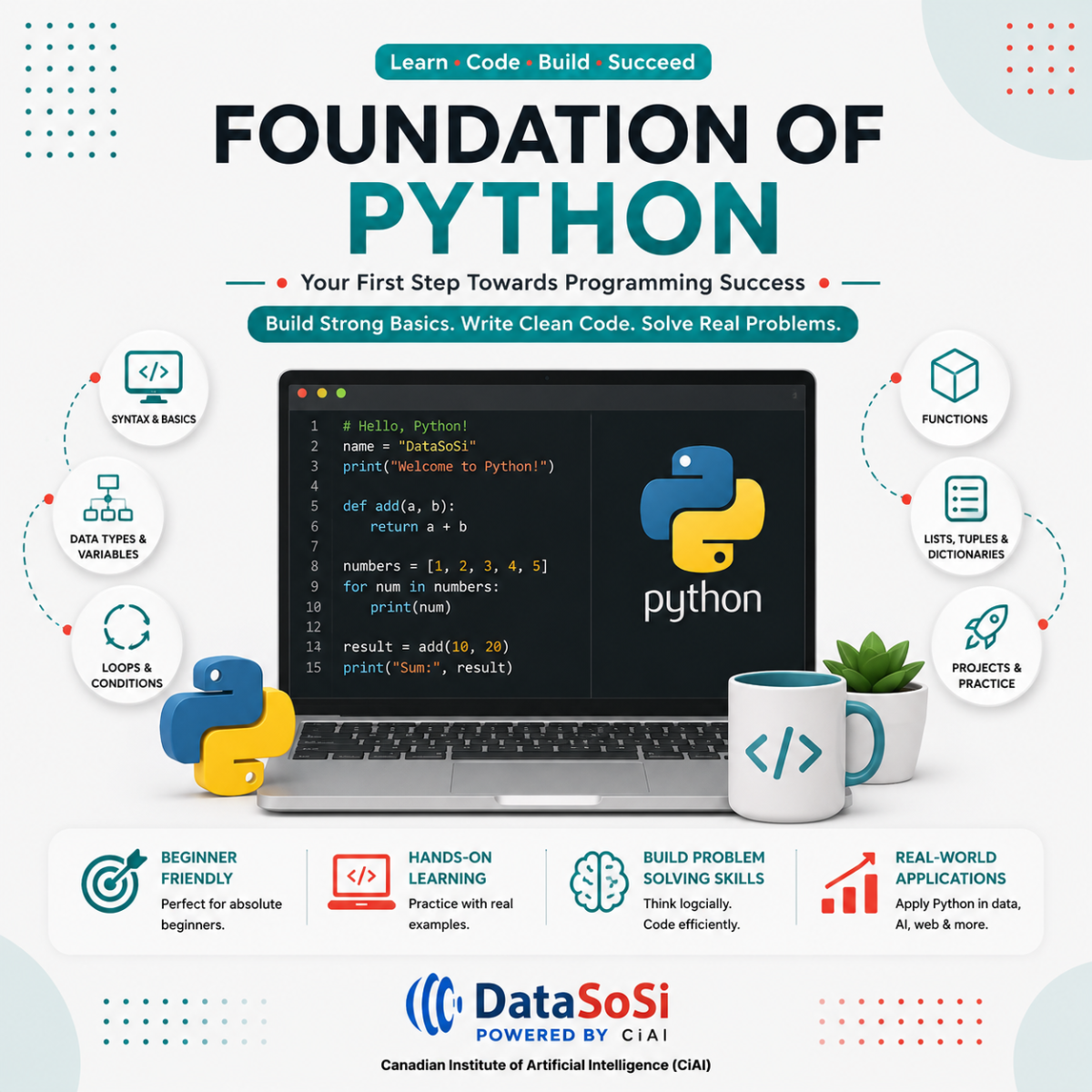
Learn Python by building increasingly complete game systems. Start with Python toolboxes, variables and decisions, then progress through loops, functions, strings and data collections before building a battle game and a complete text-based adventure.
12 instructional units · 4 project capstones · 1 final capstone · Beginner-friendly Python · Applied game logic · CiAI certificate
Original price was: USD$50.00.USD$17.23Current price is: USD$17.23. /month
Self-paced online learning designed for learners starting Python from the beginning.
Start From the Beginning
No previous programming experience is required.
Build Skills Gradually
Each unit adds another programming concept to the learner's toolkit.
Apply Python to Game Logic
Variables, decisions, loops, functions and collections are taught through game-style examples.
Build Through Capstones
Each module ends with a project capstone before students complete the final text-based adventure.
Python Foundations That Build Toward Something Real
The course is structured as a gradual build. Early units isolate one programming idea at a time. Later units combine those ideas into larger systems. By the end, students are using player data, enemies, inventories, functions, loops and decisions inside complete game logic.
The learning progression
Learn one concept → apply it to a game problem → combine it with earlier skills → build a complete system.
Core coding foundations
- Python modules and imports
- Variables and data types
- Conditions and Boolean logic
- for and while loops
- Functions, parameters and return values
- Strings and text processing
Building larger systems
- Advanced conditions and loops
- Reusable function design
- Lists and inventories
- Dictionaries and structured game data
- Player and enemy systems
- Battle loops and interactive decisions
Four Learning Stages
Stage 1 · Units 1–3
Build the Foundations
Use modules, variables, data types and conditions to give programs tools, memory and decision-making ability.
Stage 2 · Units 4–6
Automate & Organize
Use loops, functions and expanded conditional logic to create reusable and repeatable behaviour.
Stage 3 · Units 7–9
Handle More Complex Logic
Work with advanced loops, strings and larger function systems.
Stage 4 · Units 10–12
Build Complete Game Systems
Use lists, dictionaries and all previous skills to create inventories, characters and a playable battle system.
12-Unit Curriculum
Expand each unit to see what students learn and how the concept contributes to increasingly complete Python game systems.
Import and use built-in modules such as math, random, datetime, os and statistics so programs can use existing Python tools instead of rebuilding everything from scratch.
Applied Practice: Python Game Developer ToolboxStore and update integers, floats, strings and Booleans to represent player names, health, XP, coins and changing game states.
Applied Practice: Player Profile & Character StatsUse comparisons, Boolean logic and if statements so a program can respond differently depending on the current data.
Applied Practice: Game Decisions & RulesUse for and while loops to repeat actions, run turns, automate tasks and control sequences.
Applied Practice: Repeated Game ActionsCreate reusable blocks of code with parameters and return values so repeated game actions can be organized into clear functions.
Applied Practice: Reusable Game ActionsCombine multiple conditions and logical operators to create more sophisticated rules, validation and branching game behaviour.
Applied Practice: Smarter Game DecisionsUse nested loops, conditions inside loops, break and continue to manage more complex execution flows.
Applied Practice: Multi-Step Game LogicManipulate and format text for player names, menus, dialogue, story narration, item descriptions and user interaction.
Applied Practice: Dialogue & Text SystemsDesign functions that communicate through parameters and return values, then combine multiple functions into larger program systems.
Applied Practice: Modular Game SystemsStore multiple values, modify them, loop through them and use lists to represent inventories, enemy rosters and event logs.
Applied Practice: Inventory & Collection SystemsUse key-value pairs to represent structured data such as character statistics, weapons, items and other complex game objects.
Applied Practice: Character & Item DataCombine dictionaries, functions, loops, items, player choices and win/lose conditions into a complete turn-based battle game.
Major Build: First Battle Game4 Project Capstones — One for Each Module
Each module culminates in a larger project capstone that brings together the skills from that stage of the course. These are separate from the final course capstone.
Combine the Module 1 foundations: Python tools, variables and data types, conditions and decision-making, and loops and repetition. Students bring together the skills used in the Hello Hero game, Player Stats Tracker, Choose-Your-Path Adventure, and Replayable Quiz Game.
Combine functions, advanced conditions, advanced loops, and strings to create more reusable and responsive game mechanics. Students apply the skills developed through the Battle Damage Calculator, Quest Decision System, Wave Survival Challenge, and Character Dialogue Engine.
Combine advanced functions, lists, and dictionaries to manage structured game information. Students bring together skills from the Player Skill Manager, Player Inventory System, and Character Profile Database.
Build a connected Mini RPG Framework that combines character creation, inventory management, quest tracking, enemy encounters, and player progression.
Final Capstone — Build Your Own Text-Based Adventure Game
After completing the 12 instructional units, students bring the entire course together in one separate final capstone.
FINAL COURSE CAPSTONE
Build Your Own Text-Based Adventure Game
Students create a playable adventure where a character explores locations, battles enemies, collects items, makes choices and wins or loses based on those decisions.
1complete playable adventure
12instructional units brought together
Player + Enemystructured game data
Game Loopcontinuous interactive play
- Create player health, attack and inventory
- Create enemy data
- Build rooms and locations with dictionaries
- Add room descriptions and choices
- Create reusable attack logic
- Create healing logic
- Create item-use logic
- Build a turn-based battle system
- Collect items during exploration
- Move between rooms
- Continue until the player wins or loses
- Combine variables, loops, functions, lists and dictionaries
Coming Courses
Continue building Python skills through the next two DataSoSi courses.
Coming Course 1
Python Basics Overview
Continue strengthening your understanding of core Python concepts and how they work together in complete programs.
Explore Python Basics Overview →
Coming Course 2
Data Skills with Python
Move from programming foundations into practical Python data skills and begin applying code to structured data and analysis.
Explore Data Skills with Python →Course Details
CourseCore Python Foundations for Teens
LevelBeginner
Prior programming requiredNo
Instructional units12
Project capstones4 — one per module
Final capstones1
Final capstoneText-Based Adventure Game
Core languagePython
Learning styleGame-based applied coding
AI TutorIncluded
CertificateCanadian Institute of Artificial Intelligence (CiAI)
Frequently Asked Questions
Yes. No prior programming experience is required. The course begins with Python modules, variables and data types, then progressively introduces decisions, loops, functions, strings and data collections.
The course contains 12 instructional units, 4 project capstones—one for each module—and one separate final capstone.
The final capstone is Build Your Own Text-Based Adventure Game. Students combine player and enemy data, rooms, inventory, choices, functions, battle logic and a continuous game loop into one playable project.
Yes. The course supports beginner-friendly learning with guided explanations, hints, debugging support and help understanding what Python code and outputs mean.
The certificate of completion is issued by the Canadian Institute of Artificial Intelligence (CiAI).
Continue with Python Basics Overview, followed by Data Skills with Python.
The course is created by Dr. Mark Lokanan, Professor at Royal Roads University, Senior Machine Learning Engineer at Vedia, and a Senior Machine Learning & AI Scholar.
Meet the Creator of the Course
Learn from an experienced academic and applied machine-learning professional.

Dr. Mark Lokanan
Professor at Royal Roads University · Senior Machine Learning Engineer at Vedia · Senior Machine Learning & AI Scholar
Dr. Mark Lokanan is a Professor at Royal Roads University and Senior Machine Learning Engineer at Vedia. His work spans machine learning, artificial intelligence, data science, analytics and applied technology. His teaching focuses on making coding, data and AI understandable through structured, practical learning experiences.