

Currently Empty: USD$0.00
Home » Python Courses » Python III: Game Builder
Game Builder Pathway · Level 2
Python III: Game Builder
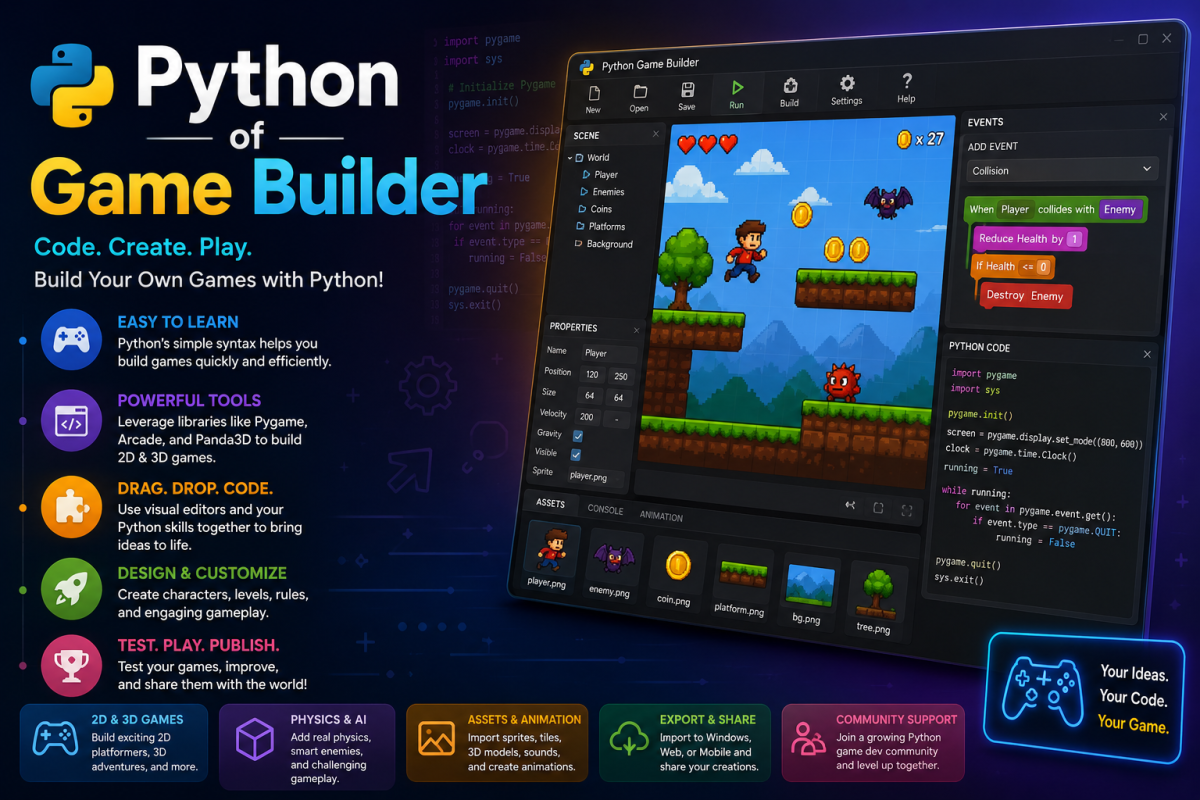
Bigger games. Cooler tricks. Same simple, fun energy. Add collectibles, moving enemies, health systems, safe zones, bullets, hit detection and a mini-boss—then combine everything into a complete arcade-style shooter.
4 modules · 8 units · 1 final capstone · Pygame + Python 3 · AI Tutor · CiAI certificate
Original price was: USD$50.00.USD$15.99Current price is: USD$15.99. /month
Self-paced online learning. Requires Game Builder Level 1 foundations.
One New Mechanic at a Time
Each unit adds one focused game mechanic so complexity grows gradually.
Playable Practice Builds
Students test each mechanic in a small game moment before combining systems.
Same Beginner-Friendly Tools
Rectangles, variables, conditions, loops and familiar Pygame patterns do the heavy lifting.
One Final Arcade Shooter
Unit 8 combines the course into one complete Mini Arcade Shooter capstone.
Four Modules — One Connected Game-Building Journey
Module 1
Game Movement Fundamentals
Build on movement foundations and introduce automated moving objects.
Module 2
Controlling Movement
Keep objects inside the game world and control how fast they move.
Module 3
Interactive Game Mechanics
Add bouncing and repeated automated behaviour to create richer gameplay.
Module 4
Bringing Games to Life
Use animation and combine the course into a finished game experience.
8-Unit Curriculum
The outline organizes the course into four modules and eight units. The collapsible units below use the detailed Level 2 course files to show the actual mechanic and practice build for each unit.
Add collectible items with rectangle collision detection and track score.
Practice Build: Collect the SquaresProgram enemies that move automatically, vary in speed and reset after leaving the screen.
Practice Build: Avoid the Red BlockCreate a health bar with rectangles, reduce health on collision and end the game at zero health.
Practice Build: Survive for 10 SecondsKeep the player inside the screen and add a safe zone where collision damage is disabled.
Practice Build: Stay in the Box!Fire rectangle bullets with the spacebar and move them automatically through the game window.
Practice Build: Block BlasterDetect bullet-enemy collisions, respawn enemies and increase the score.
Practice Build: Target PracticeCreate a larger enemy with more health, slower movement and multi-hit combat.
Practice Build: Boss Fight LiteCombine movement, enemies, shooting, scoring, boss mechanics and simple win/lose conditions.
Final Capstone: Mini Arcade ShooterOne Final Capstone — Mini Arcade Shooter
This course has one capstone. Unit 8 brings the mechanics from the earlier units into a single arcade-style game.
FINAL COURSE CAPSTONE
Build the Mini Arcade Shooter
Students combine the mechanics developed across the course into one playable game with movement, threats, shooting, scoring, a boss encounter and simple win/lose conditions.
4modules connected
8units integrated
7earlier mechanics carried forward
1final arcade shooter
- Player movement
- Collectibles and scoring
- Moving enemies
- Health and lives
- Boundaries and safe zones
- Shooting and projectiles
- Enemy hit detection
- Enemy respawning
- Mini-boss combat
- Win and lose conditions
Continue Your Python Path
After completing Python III: Game Builder, students can broaden their Python skills from game development into data work, real-world projects and data communication.
Next Course 1
Data Skills with Python
Move from game-focused programming into practical Python for data, building the foundation for analysis and data-driven problem solving.
Continue to Data Skills with Python →Next Course 2
Python Real-World Project
Apply Python skills to realistic problems and complete project-based work that strengthens practical coding and problem-solving experience.
Continue to Python Real-World Project →Next Course 3
Data Storytelling
Learn how to turn analysis into clear insights, visuals and explanations that help an audience understand what the data means.
Continue to Data Storytelling →Course Details
CoursePython III: Game Builder
PathwayGame Builder Pathway – Level 2
Modules4
Units8
Final capstones1
Final capstoneMini Arcade Shooter
Core toolsPython 3 · Pygame
PrerequisiteGame Builder Level 1
AI TutorIncluded
CertificateCanadian Institute of Artificial Intelligence (CiAI)
Frequently Asked Questions
This course is beginner-safe for students who have completed Game Builder Level 1 and are comfortable with a Pygame window, frame-based game loop, rectangle drawing, keyboard input, collision detection, variables and conditions.
The course contains 4 modules and 8 units.
The course has one final capstone: the Mini Arcade Shooter. The earlier unit builds are practice projects and are not counted as separate capstones.
Yes. Students receive guided explanations, hints, debugging support and help understanding what their code and game behaviour mean.
The certificate of completion is issued by the Canadian Institute of Artificial Intelligence (CiAI).
Continue with Data Skills with Python, then Python Real-World Project, followed by Data Storytelling.
The course is created by Dr. Mark Lokanan, Professor at Royal Roads University, Senior Machine Learning Engineer at Vedia, and a Senior Machine Learning & AI Scholar.
Meet the Creator of the Course
Learn from a senior machine-learning and AI scholar with academic and applied technology experience.
Dr. Mark Lokanan
Professor · Senior Machine Learning Engineer at Vedia · Senior Machine Learning & AI Scholar
Dr. Mark Lokanan is a Professor at Royal Roads University and Senior Machine Learning Engineer at Vedia. His work spans machine learning, artificial intelligence, data science, analytics and applied technology. His teaching focuses on making coding and AI practical and understandable through structured projects that show learners how individual pieces of code connect into complete systems.