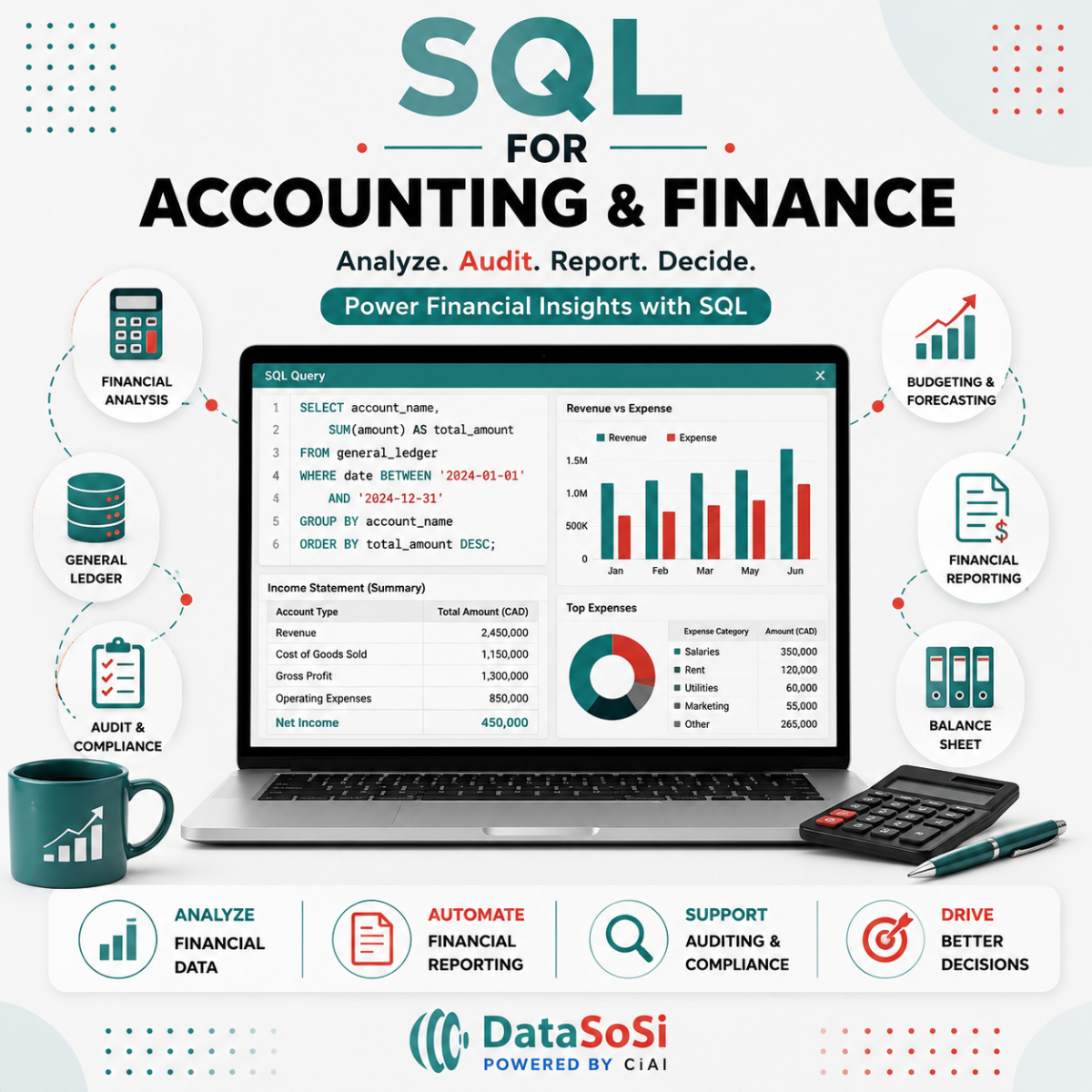
SQL Accounting & Finance Analytics
Use SQL to trace financial transactions, analyze revenue and expenses, manage receivables and payables, and build financial reports.
3 course parts · 3 capstone projects · 13-table financial database · AI Tutor · Certificate issued by CiAI.
Self-paced online · Designed for learners who completed SQL Basics and SQL Beginner, or have equivalent foundational SQL skills.
Work with Real Financial Data
Use ERP-style tables for accounts, journal entries, general ledger, invoices, bills, payments and bank transactions.
Analyze Revenue, Expenses & Cash
Connect customer, vendor and ledger data to answer practical accounting and finance questions.
Build Financial Reports with SQL
Create Income Statement and Balance Sheet views, cash flow analysis, AR/AP reporting and anomaly checks.
3 Applied Capstone Projects
Complete one accounting and finance capstone after each course part.
Turn Financial Records into Decision-Ready Insight with SQL
Modern accounting systems store financial activity across interconnected tables rather than in one report. This course teaches learners how SQL connects the chart of accounts, journal entries, general ledger, invoices, customer payments, vendors, bills, vendor payments and bank transactions so financial activity can be traced from individual transactions to management-level reporting.
Why take SQL Accounting & Finance after SQL Basics and SQL Beginner?
SQL Basics and SQL Beginner teach the core language. SQL Accounting & Finance applies those skills to real financial questions: Which customers generate the most revenue? Which vendors account for the highest expenses? Which invoices remain outstanding? What does the general ledger show? How much cash came in and went out? Which transactions appear unusual?
What you will learn
- Understand the chart of accounts and financial classifications
- Explore double-entry journal records using debit and credit fields
- Trace posted activity through the general ledger
- Analyze customers, vendors, invoices, payments and bills
- Filter financial activity by reporting period
- Join invoices to customers for revenue analysis
- Join bills to vendors for supplier expense analysis
- Identify outstanding receivables and unpaid obligations
- Aggregate financial data with GROUP BY and HAVING
- Build Income Statement and Balance Sheet views
- Analyze cash inflows and outflows
- Perform receivables aging and accounts payable analysis
- Detect unusual financial transactions using SQL patterns
Who this course is for
- Accounting and finance professionals
- Financial analysts and management-reporting professionals
- Bookkeeping, receivables and payables professionals
- Business analysts working with ERP or financial data
- Audit, compliance and financial-operations learners
- Non-technical professionals moving into financial analytics
SQL Accounting & Finance Analytics Curriculum: 3 Applied Parts
The course follows the structure defined in the course materials: financial data foundations, intermediate financial SQL queries, and advanced financial analytics and reporting.
Learn how financial data is organized before moving into multi-table analysis.
- Query the accounts table and understand financial classifications
- Explore journal_entries and double-entry transaction records
- Retrieve general_ledger data and understand posted summaries
- Examine customers and vendors as financial business relationships
- Explore invoices, customer payments and bills
- Filter financial activity using financial_periods
- SQL skills: SELECT, column selection, WHERE and data exploration
- Capstone 1: Financial Data Foundations Report
Connect financial tables and answer real accounting questions using joins and grouped analysis.
- Join invoices and customers to analyze revenue by customer
- Join bills and vendors to analyze expenses by supplier
- Combine journal_entries, accounts and general_ledger to trace transactions
- Use customer payments and invoices to identify outstanding receivables
- Use bills and vendor payments to analyze accounts payable
- Aggregate financial data using GROUP BY and HAVING
- SQL skills: INNER/LEFT JOIN, aggregation and multi-table analysis
- Capstone 2: Receivables, Payables & Transaction Trace Analysis
Transform ledger and transaction data into financial reports and analytical insights.
- Build an Income Statement using general_ledger and accounts
- Generate Balance Sheet views from categorized accounts
- Perform cash flow analysis using bank_transactions and payments
- Conduct accounts receivable aging using invoices and customer payments
- Analyze accounts payable using bills and vendor data
- Detect anomalies and unusual transactions using journal_entries patterns
- SQL skills: advanced aggregation, CASE, subqueries and reporting logic
- Capstone 3: Financial Reporting & Cash Flow Analytics Dashboard
Follow the Financial Analytics Workflow End to End
Example: calculate total invoiced revenue by customer
The invoices table stores billed amounts, while customers identifies who was billed. Joining the two tables turns transaction records into customer-level revenue analysis.
The course extends this same pattern into supplier expenses, receivables, payables, financial statements, cash flow and exception analysis.
3 Hands-On SQL Accounting & Finance Capstone Projects
The course includes exactly 3 capstone projects — one after each course part — covering financial data foundations, receivables and payables, transaction tracing, financial reporting and cash flow.
Financial Data Foundations Report
Build a structured financial overview using accounts, journal entries, the general ledger, customers, vendors, invoices, bills and reporting periods.
Skills: SELECT, WHERE, financial classifications, debits/credits, period filtering.
Receivables, Payables & Transaction Trace Analysis
Connect customers, invoices, payments, vendors, bills, journal entries and ledger records to analyze revenue, expenses, AR, AP and transaction flow.
Skills: JOINs, GROUP BY, HAVING, multi-table financial analysis.
Financial Reporting & Cash Flow Analytics Dashboard
Create a decision-ready SQL analysis covering Income Statement activity, Balance Sheet categories, cash flow, receivables aging, payables and unusual transactions.
Skills: advanced aggregation, CASE, subqueries, financial reporting logic.
Recommended SQL Learning Path After This Course
Assuming you completed SQL Basics and SQL Beginner, continue building deeper SQL capability after SQL Accounting & Finance with the following courses.
SQL Intermediate
Strengthen query logic with subqueries, CTEs, advanced filtering and data cleaning.
Explore SQL Intermediate →SQL Advance
Move into advanced set logic, window functions, performance and BI-ready SQL.
Explore SQL Advance →SQL AI-Assisted
Learn to generate, inspect, debug and verify SQL with AI while keeping human judgment in control.
Explore SQL AI-Assisted →SQL Data Analytics
Broaden into applied analytical SQL for BI, data engineering and machine-learning preparation.
Explore SQL Data Analytics →Course Details
Frequently Asked Questions
This course is designed for accounting and finance professionals, financial analysts, bookkeeping and reporting professionals, business analysts, and learners who want practical SQL experience with financial data.
The course includes exactly 3 capstone projects: 1) Financial Data Foundations Report, 2) Receivables, Payables & Transaction Trace Analysis, and 3) Financial Reporting & Cash Flow Analytics Dashboard.
The certificate of completion is issued by the Canadian Institute of Artificial Intelligence (CiAI).
The database contains 13 connected tables: accounts, customers, vendors, financial_periods, journal_entries, general_ledger, invoices, invoice_lines, customer_payments, bills, bill_lines, vendor_payments and bank_transactions.
Part 1 covers the chart of accounts, journal entries, general ledger, customers, vendors, invoices, payments, bills and financial periods using SELECT, column selection and WHERE filtering.
Part 2 covers financial JOINs, revenue by customer, expenses by vendor, transaction tracing, outstanding receivables, accounts payable, GROUP BY, HAVING and multi-table analysis.
Part 3 covers Income Statement analysis, Balance Sheet views, cash flow, accounts receivable aging, accounts payable and unusual transaction detection.
Yes. Learners use the general_ledger and accounts tables to build Income Statement and Balance Sheet views.
Yes. The course uses invoices, customer payments, bills, vendor payments and vendor/customer records to analyze receivables and payables.
Yes. Learners analyze cash inflows and outflows using bank_transactions and payment data.
Yes. Part 3 includes identifying unusual journal-entry patterns and suspiciously large or atypical financial transactions using SQL filters and aggregation.
Assuming you completed SQL Basics and SQL Beginner, recommended next courses are SQL Intermediate, SQL Advance, SQL AI-Assisted and SQL Data Analytics.
For current subscription, cancellation and refund information, visit the DataSoSi FAQ page or Contact Us.
Meet the Creator of the Course
Learn from an educator and machine learning engineer working across analytics, AI, data science and applied business problems.

Dr. Mark Lokanan
Professor · Senior Machine Learning Engineer · Data Scientist · AI Specialist
Dr. Mark Lokanan is a professor at Royal Roads University and a Senior Machine Learning Engineer at Vedia. His work spans data science, machine learning, artificial intelligence, analytics, financial crime, and applied research. Drawing on both academic and industry experience, he designed SQL Accounting & Finance Analytics to help learners apply SQL to financial records, revenue, expenses, receivables, payables, general-ledger analysis, cash flow and financial reporting.

