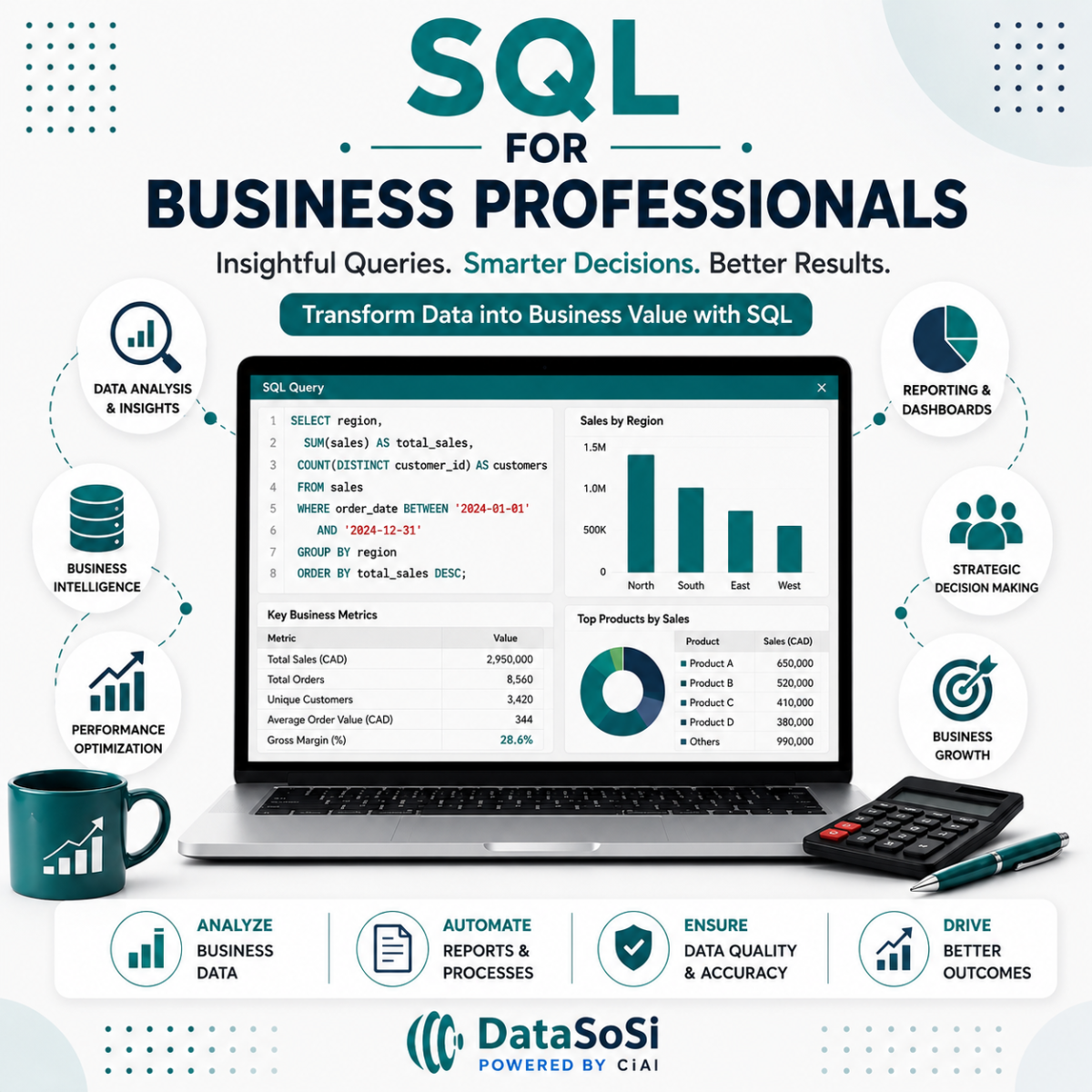
SQL Foundations for Business Professionals
Learn practical SQL for everyday business questions across customers, sales, marketing, finance and operations.
3 course parts · 10 core business tables · 3 applied capstone projects · AI Tutor · Certificate issued by CiAI.
Self-paced online · Beginner-friendly · No prior technical experience required.
Built for Business Professionals
Learn SQL through customer, sales, marketing, finance and operations questions rather than abstract database exercises.
Work with 10 Realistic Business Tables
Use customers, orders, products, payments, employees, departments, website sessions and campaign data.
Move from Queries to Decisions
Progress from SELECT and WHERE to joins, grouped metrics, ROI, customer value and executive reporting.
3 Applied Capstone Projects
Complete one capstone aligned with each course part: foundations, analysis and decision support.
Learn SQL Through the Business Questions Professionals Actually Ask
This course is designed for non-technical professionals who need to work with business data but do not want a programming-heavy introduction. Learners use realistic customer, sales, product, payment, employee and marketing data to answer practical questions that support reporting and decision-making.
What makes this course practical?
Rather than learning SQL as isolated syntax, you use it to answer questions such as: How many customers do we have? What are total sales? Which products generate the most revenue? Which campaigns are profitable? Who are our most valuable customers? How is workforce and financial performance changing?
What you will learn
- Understand how business data is organized into tables, rows and columns
- Retrieve specific business data with SELECT
- Filter customer, order, product and payment records with WHERE
- Sort and limit business results with ORDER BY and LIMIT
- Summarize data with COUNT, SUM and AVG
- Connect customers, orders, products and other tables with JOINs
- Aggregate business metrics with GROUP BY and HAVING
- Analyze customer purchase patterns and product performance
- Evaluate sales, revenue, website and campaign performance
- Segment customers and estimate customer lifetime value
- Analyze employee and department metrics
- Perform basic financial analysis of revenue, payments and profit
- Build business reports that support management decisions
Who this course is for
- Business professionals with little or no technical background
- Managers who need to understand and query operational data
- Aspiring business analysts
- Marketing and sales professionals
- Finance and operations professionals
- Professionals who want a practical foundation before more advanced SQL courses
SQL Foundations for Business Professionals: 3-Part Curriculum
The course follows the progression in the source materials: start with business data foundations, move into cross-department analysis, and finish with business insights and decision support.
Understand business data and write your first practical SQL queries.
- Understanding business data tables
- Customers, orders and products overview
- SELECT statement basics
- Filtering business data with WHERE
- Sorting and limiting results with ORDER BY and LIMIT
- Summarizing data with COUNT, SUM and AVG
- Applied Capstone 1: Business Data Foundations Report
Connect data across departments and convert individual records into useful business metrics.
- Joining tables: customers + orders + products
- Aggregating business metrics with GROUP BY
- Filtering grouped results with HAVING
- Customer behavior analysis
- Sales and revenue analysis
- Marketing and website analytics
- Applied Capstone 2: Cross-Department Business Analysis
Use SQL to solve broader business problems and create decision-ready reports.
- Customer segmentation and lifetime value
- Sales trends and growth analysis
- Marketing performance and ROI
- Employee and department performance
- Financial analysis: revenue, payments and profit
- Business reporting and decision support
- Applied Capstone 3: Executive Business Decision Report
Follow the Business Analytics Workflow End to End
Example: identify top customers by revenue
Business professionals often need ranked summaries rather than raw transaction rows. SQL can aggregate customer purchases and order the results by business value.
The course applies the same logic to products, campaigns, departments, payments and broader business reporting.
3 Applied SQL Capstone Projects for Business Professionals
The course includes exactly 3 applied capstone projects — one aligned with each course part — so learners progress from foundational business queries to cross-department analysis and decision support.
Business Data Foundations Report
Build a simple business report using customer, order, product, payment and employee records with SELECT, WHERE, sorting and summary functions.
Skills: SELECT, WHERE, ORDER BY, LIMIT, COUNT, SUM, AVG.
Cross-Department Business Analysis
Connect customers, orders, products, website sessions and campaigns to analyze customer behavior, sales performance and marketing activity.
Skills: JOINs, GROUP BY, HAVING, customer analysis, revenue analysis.
Executive Business Decision Report
Create a decision-ready SQL report combining customer value, sales trends, campaign ROI, workforce metrics and financial performance.
Skills: segmentation, trends, ROI, employee metrics, profit analysis, reporting.
Recommended Next SQL Courses
After completing SQL Foundations for Business Professionals, continue with courses that deepen your SQL capability and move you into more specialized analytical work.
SQL Beginner
Strengthen foundational SQL with filtering, NULL handling, aggregation, joins and advanced filtering.
Explore SQL Beginner →SQL Intermediate
Build stronger query logic with subqueries, CTEs, advanced filtering and data cleaning.
Explore SQL Intermediate →SQL Data Analytics
Apply SQL to BI, data engineering and machine-learning preparation.
Explore SQL Data Analytics →SQL AI-Assisted
Learn to generate, inspect, debug and verify SQL with AI while maintaining human judgment.
Explore SQL AI-Assisted →Course Details
Frequently Asked Questions
This course is designed for non-technical business professionals, managers, aspiring business analysts and learners who want practical SQL skills for sales, customer, marketing, finance and operations data.
No. The course materials describe the course as beginner-friendly and state that no prior technical experience is required.
The course includes exactly 3 applied capstone projects: 1) Business Data Foundations Report, 2) Cross-Department Business Analysis, and 3) Executive Business Decision Report.
The certificate of completion is issued by the Canadian Institute of Artificial Intelligence (CiAI).
The course uses 10 core tables: customers, orders, order_items, products, payments, employees, departments, website_sessions, marketing_campaigns and campaign_performance.
Part 1 covers business data tables, customers/orders/products, SELECT, WHERE, ORDER BY, LIMIT, COUNT, SUM and AVG.
Part 2 covers joins, GROUP BY, HAVING, customer behavior, sales and revenue analysis, and marketing and website analytics.
Part 3 covers customer segmentation and lifetime value, sales trends, marketing ROI, employee and department performance, financial analysis and business decision support.
The course materials connect these skills to Business Analyst, Marketing Analyst, Financial Analyst and Operations Analyst work, including customer analysis, KPI reporting, campaign analysis, financial reporting and operational reporting.
Recommended next courses include SQL Beginner, SQL Intermediate, SQL Data Analytics and SQL AI-Assisted, depending on how much foundational SQL you already have and the direction you want to develop.
For current subscription, cancellation and refund information, visit the DataSoSi FAQ page or Contact Us.
Meet the Creator of the Course
Learn from an educator and machine learning engineer working across analytics, AI, data science and applied business problems.

Dr. Mark Lokanan
Professor · Senior Machine Learning Engineer · Data Scientist · AI Specialist
Dr. Mark Lokanan is a professor at Royal Roads University and a Senior Machine Learning Engineer at Vedia. His work spans data science, machine learning, artificial intelligence, analytics, financial crime, and applied research. Drawing on both academic and industry experience, he designed SQL Foundations for Business Professionals to help non-technical learners use SQL to answer practical questions across customers, sales, products, marketing, finance, workforce and business reporting.

