Currently Empty: USD$0.00
Home » SQL Courses » SQL for Fraud Detection & Risk Analytics
◆ Featured
SQL for Fraud Detection & Risk Analytics
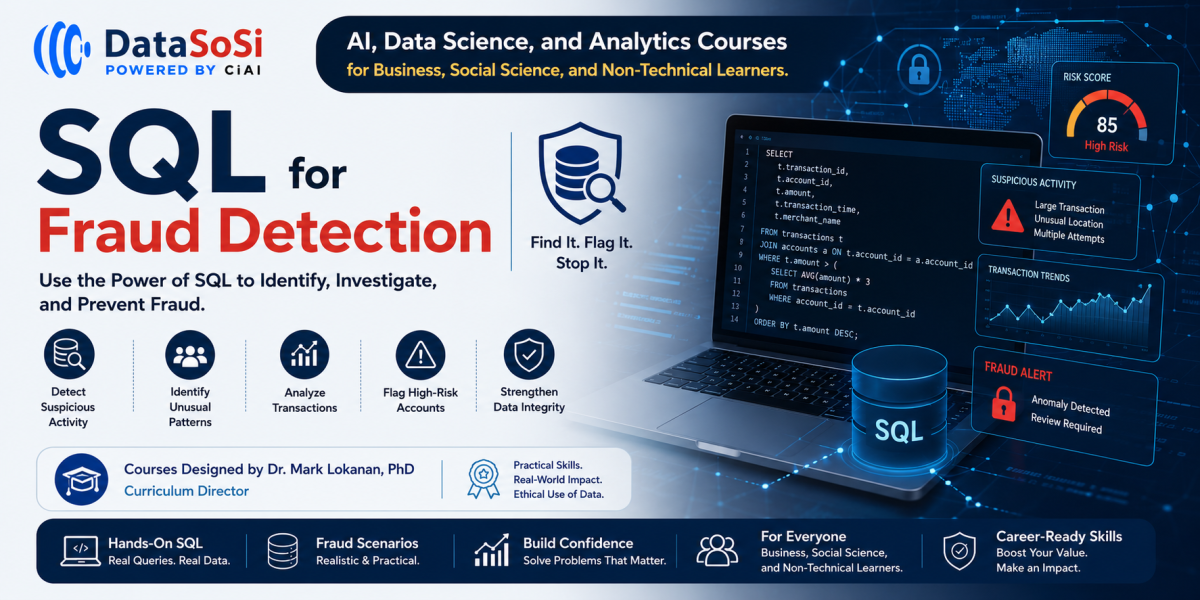
Use SQL to investigate suspicious financial activity, analyze risk signals and support fraud and AML investigations.
3 course parts · 10 connected fraud & AML tables · 3 capstone projects · AI Tutor · Certificate issued by CiAI.
Original price was: USD$50.00.USD$15.99Current price is: USD$15.99. /month
Self-paced online · Built around realistic banking, fintech, e-commerce and compliance data.
Complete enrollment through DataSoSi checkout. Payment options depend on checkout configuration.
Investigate Real Fraud & Risk Data
Work with the same types of connected data used across banking, fintech, e-commerce and compliance systems.
Trace Activity Across Tables
Connect customers, accounts, transactions, merchants and devices to understand the context behind suspicious activity.
Analyze Fraud, AML & Risk Signals
Use fraud alerts, cases, AML alerts, sanctions screening and risk scores to support investigation and escalation.
3 Applied Capstone Projects
Complete one capstone after each course part to apply fraud-data, detection and investigation skills.
Learn SQL Through Real Fraud, Risk and AML Workflows
This course is not SQL taught in isolation. The uploaded course materials are built around how fraud and financial-crime data is actually organized across financial systems. Learners work from customer and account information into transaction behavior, merchant and device context, fraud alerts, cases, AML alerts, sanctions screening and risk scores.
What will you learn to investigate?
You will use SQL to explore questions such as: Which customers carry higher risk? Which accounts are dormant or unusual? Which transactions are large, frequent or geographically unusual? Which merchants are flagged as higher risk? Which alerts are escalating into cases? How do AML alerts, sanctions matches and customer risk scores relate to observed activity?
customers & accountsidentity · KYC · risk · account relationships
transactionsamount · type · time · location · status
merchants & devicesrisk flags · access context · IP · device type
alerts & risk systemsfraud · AML · cases · sanctions · risk scores
What you will learn
- Understand how fraud and AML data is structured in real-world systems
- Query customer risk profiles and KYC status
- Explore financial accounts and customer-account relationships
- Retrieve transaction activity and investigate behavior patterns
- Use merchant and device data to add context to transactions
- Identify indicators based on location, amount and transaction frequency
- Filter transaction data to isolate suspicious patterns
- Join transactions and accounts to trace financial activity
- Join customers and transactions to analyze behavior
- Combine transactions and merchants to identify risky merchant activity
- Use timestamps to identify unusual transaction frequency
- Aggregate transaction activity to identify high-value or abnormal patterns
- Use GROUP BY and HAVING to detect anomalies
- Perform transaction anomaly and velocity analysis
- Analyze fraud alerts, fraud cases, AML alerts, sanctions results and customer risk scores
Who this course is for
- Fraud analysts and aspiring fraud analysts
- Risk analysts
- AML and financial-crime analysts
- Compliance professionals
- Investigators working with transaction or alert data
- Data analysts moving into fraud, risk or financial-crime analytics
SQL for Fraud Detection & Risk Analytics: 3-Part Curriculum
The source course progresses from understanding fraud and risk data, to connecting that data with SQL, and then to advanced fraud and AML investigation analytics.
Explore the core fraud-related tables and learn how customer behavior and financial activity are represented in structured data.
- Query the customers table to understand risk profiles
- Explore accounts to understand financial relationships
- Retrieve transaction data to understand activity patterns
- Examine merchants and devices to understand behavior context
- Identify key fraud indicators such as location, amount and frequency
- Filter transaction data to isolate suspicious patterns
- Applied SQL: SELECT, DISTINCT, WHERE, COUNT, GROUP BY, ORDER BY
- Capstone 1: Fraud & Risk Data Foundations Investigation
Connect multiple tables and identify suspicious activity using intermediate SQL.
- Join transactions and accounts to trace financial activity
- Join customers and transactions to analyze behavior
- Combine transactions and merchants to identify risky merchants
- Use transaction timestamps to detect unusual frequency patterns
- Aggregate transaction data to identify high-value or abnormal activity
- Identify anomalies using GROUP BY and HAVING
- Applied SQL: INNER/LEFT JOIN, aggregation, GROUP BY, HAVING, multi-table analysis
- Capstone 2: Suspicious Transaction & Behavior Analysis
Apply SQL to detect fraud patterns and support fraud, AML and compliance investigations.
- Perform transaction anomaly detection using transaction patterns
- Conduct velocity checks to detect rapid transactions
- Analyze fraud alerts and cases to identify trends
- Evaluate customer risk using risk_scores and behavior data
- Analyze AML alerts and sanctions-screening results
- Detect suspicious relationships across accounts and transactions
- Applied SQL: advanced aggregation, CASE, subqueries and analytical reasoning
- Capstone 3: Fraud, AML & Risk Investigation Analytics
Follow the Fraud & Risk Investigation Workflow End to End
1. Understand the EntityStart with customer risk, KYC status, accounts, merchants and devices.
→
2. Investigate the ActivityTrace transactions, frequency, amounts, locations, merchant exposure and anomalies.
→
3. Support the CaseConnect alerts, cases, risk scores, AML activity and sanctions results for investigation.
Part 3 · Velocity Check
Example: identify repeated transactions by account and date
Velocity analysis helps identify accounts with repeated activity over a short time window.
SELECT
account_id,
DATE(transaction_date) AS txn_date,
COUNT(*) AS total_transactions
FROM transactions
GROUP BY account_id, DATE(transaction_date)
HAVING COUNT(*) > 1;
-- Shows account/date combinations with more than one transaction.
The course then extends this logic into fraud alerts, cases, customer risk, AML alerts, sanctions screening and suspicious relationships.
3 Applied Fraud, Risk & AML Capstone Projects
The course includes exactly 3 capstone projects — one after each course part. The capstone names below are aligned to the three source parts and summarize the skills each part develops.
Capstone 1
Fraud & Risk Data Foundations Investigation
Explore customers, accounts, transactions, merchants and devices, then identify basic fraud indicators using structured SQL analysis.
Focus: risk profiles, KYC, account context, transaction patterns, merchant risk and device context.
Capstone 2
Suspicious Transaction & Behavior Analysis
Join multiple tables to trace activity, connect customers to transactions, examine merchant risk and detect unusual frequency or high-value patterns.
Focus: JOINs, timestamps, aggregation, GROUP BY, HAVING and multi-table analysis.
Capstone 3
Fraud, AML & Risk Investigation Analytics
Investigate transaction anomalies, velocity, fraud alerts, cases, customer risk scores, AML alerts, sanctions screening and suspicious account relationships.
Focus: advanced fraud analytics, AML analysis, risk interpretation and investigation support.
Recommended Next SQL Courses
After SQL for Fraud Detection & Risk Analytics, continue with courses that deepen relational SQL, analytical SQL and AI-assisted query development.
Next 1
SQL Joins
Deepen relational analysis, reconciliation, missing-match detection and multi-table reporting.
Explore SQL Joins →Next 2
SQL Intermediate
Strengthen SQL with subqueries, CTEs, advanced filtering and data cleaning.
Explore SQL Intermediate →Next 3
SQL Data Analytics
Apply SQL to BI, data engineering and machine-learning preparation.
Explore SQL Data Analytics →Next 4
SQL AI-Assisted
Develop stronger prompting, debugging and verification skills for AI-assisted SQL workflows.
Explore SQL AI-Assisted →Course Details
Format100% self-paced, online
LevelFoundational to advanced applied fraud SQL
Structure3 connected course parts
Working databasefraud_sql_course
Tables10 connected fraud, AML and risk tables
Core tablescustomers, accounts, transactions, merchants, devices, fraud_alerts, fraud_cases, aml_alerts, sanctions_screening, risk_scores
Industry contextBanking, fintech, e-commerce and compliance systems
Career relevanceFraud Analyst, Risk Analyst, AML Analyst, Financial Crime Analyst
AI TutorIncluded — fraud, risk and AML-specific guidance
Capstone ProjectsExactly 3 — one after each course part
CertificateIssued by the Canadian Institute of Artificial Intelligence (CiAI)
Frequently Asked Questions
The course is designed for fraud analysts, risk analysts, AML and financial-crime professionals, compliance staff, investigators and data analysts who want practical SQL skills for financial-crime analysis.
There are 3 parts: 1) Fraud & Risk Data Foundations, 2) Fraud Detection SQL Queries, and 3) Fraud & AML Analytics.
The course includes exactly 3 capstone projects, one aligned with each of the three course parts.
The working fraud_sql_course database contains 10 connected tables: customers, accounts, transactions, merchants, devices, fraud_alerts, fraud_cases, aml_alerts, sanctions_screening and risk_scores.
Part 1 focuses on fraud and risk data foundations: customers, accounts, transactions, merchants, devices, key fraud indicators and filtering suspicious patterns.
Part 2 focuses on fraud-detection SQL queries: joining transactions, accounts, customers and merchants; transaction timestamps; aggregation; high-value activity; and anomalies using GROUP BY and HAVING.
Part 3 focuses on fraud and AML analytics: transaction anomalies, velocity checks, fraud alerts and cases, customer risk, AML alerts, sanctions screening and suspicious relationships.
Yes. The customers table includes risk_level and kyc_status, and the course uses those fields to understand customer risk profiles and compliance context.
Yes. Merchant risk flags and device information such as device type, IP address and last-login context are used to add behavioral context to transactions.
Yes. Part 3 explicitly includes AML alerts, sanctions-screening results and customer risk scores as part of advanced fraud and compliance investigation analytics.
The certificate of completion is issued by the Canadian Institute of Artificial Intelligence (CiAI).
Recommended next courses are SQL Joins, SQL Intermediate, SQL Data Analytics and SQL AI-Assisted.
For current subscription, cancellation and refund information, visit the DataSoSi FAQ page or Contact Us.
Meet the Creator of the Course
Learn from an educator and machine learning engineer working across analytics, AI, data science and applied business problems.

Dr. Mark Lokanan
Professor · Senior Machine Learning Engineer · Data Scientist · AI Specialist
Dr. Mark Lokanan is a professor at Royal Roads University and a Senior Machine Learning Engineer at Vedia. His work spans data science, machine learning, artificial intelligence, analytics, financial crime, and applied research. He designed SQL for Fraud Detection & Risk Analytics to help learners use SQL to investigate transaction behavior, fraud indicators, customer risk, AML alerts, sanctions screening and financial-crime cases.
SQL Fraud Detection & Risk Assistant
Ask me about the 3 course parts, 3 capstones, the 10-table fraud database, customer risk, accounts, transactions, merchants, devices, fraud alerts, cases, AML alerts, sanctions screening, risk scores, velocity checks or next courses.