Currently Empty: USD$0.00
Uncategorized
SQL for Fraud Detection & Risk Analytics
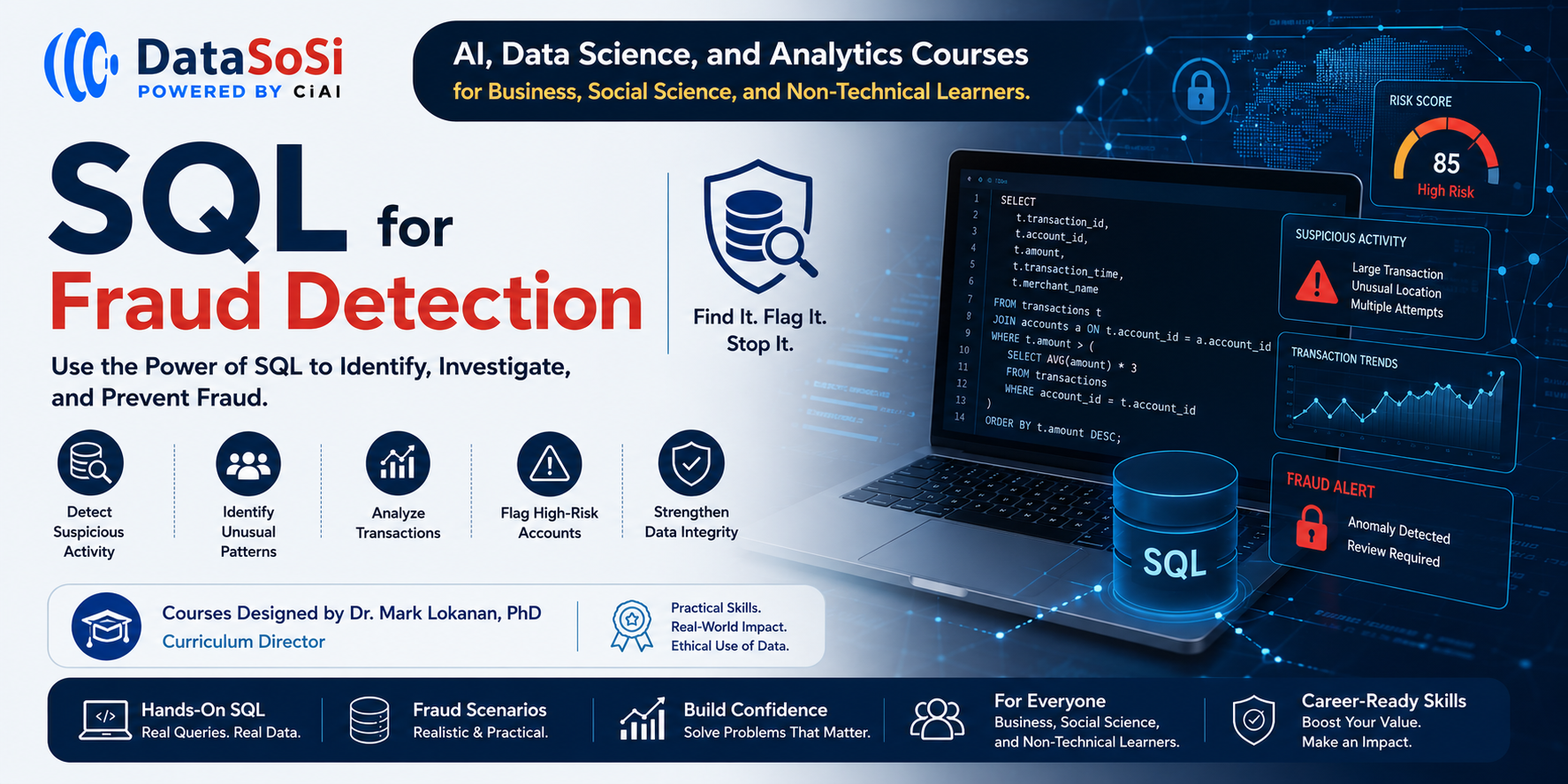
Learn to Analyze Suspicious Transactions, Risk & AML Data
Fraud detection and financial crime prevention increasingly depend on the ability to turn complex data into actionable intelligence. Banks, fintech companies, e-commerce platforms and compliance teams work with millions of transactions and interconnected records involving customers, accounts, merchants, devices, alerts and risk systems.
For professionals working with this data, SQL is more than a database skill. It is a practical analytical tool for investigating suspicious activity, connecting risk signals and understanding relationships hidden across multiple datasets.
That is exactly what SQL for Fraud Detection & Risk Analytics by DataSoSi is designed to teach.
This self-paced online course provides a practical environment for learning SQL through fraud detection, risk analytics, AML and financial-crime investigation workflows. Instead of learning SQL in isolation, students work with connected fraud and risk data designed around realistic banking, fintech, e-commerce and compliance scenarios.
Why Learn SQL for Fraud Detection and Risk Analytics?
Modern fraud investigations rarely depend on a single transaction or isolated data point. An unusual transaction may become more meaningful when connected to the customer’s risk profile, account history, merchant information, device details or previous alerts.
SQL provides the foundation for connecting these pieces of information.
With SQL, fraud and risk professionals can analyze transaction volumes, investigate unusual activity, identify high-value patterns, examine transaction frequency, connect customers with accounts and transactions, and bring multiple risk indicators together for investigation.
This makes SQL for fraud detection a valuable skill for professionals entering or developing careers in fraud analytics, risk analytics, AML and financial crime.
SQL for Fraud Detection: From Transactions to Risk Intelligence
Fraud and AML data is often distributed across multiple interconnected tables. Understanding how these datasets relate to one another is essential for meaningful analysis.
The DataSoSi course works with 10 connected fraud, AML and risk tables, including:
- Customers
- Accounts
- Transactions
- Merchants
- Devices
- Fraud alerts
- Fraud cases
- AML alerts
- Sanctions screening
- Risk scores
This structure allows learners to understand how SQL can be used across an investigation rather than treating each dataset independently.
You learn to move from customer and account context to transaction behavior, then connect that activity with fraud alerts, AML information, sanctions screening and risk indicators.
Learn SQL for Fraud Analytics Through Real Investigation Workflows
A major advantage of this course is its focus on practical investigation workflows.
The learning process follows a logical progression:
1. Understand the Customer and Account
Begin by examining customer information, KYC status, risk profiles, account relationships and account activity.
This establishes the context required before investigating individual transactions.
2. Analyze Transaction Behavior
Examine transaction amounts, timestamps, locations, transaction types and statuses to identify unusual activity.
You learn how SQL can help isolate patterns involving transaction frequency, high-value activity and other potential indicators.
3. Connect Related Data
Fraud analysis becomes significantly more powerful when information from different systems can be connected.
The course develops practical skills in joining customers, accounts, transactions, merchants and devices to trace activity across the data.
4. Investigate Alerts and Risk Signals
The investigation can then extend into fraud alerts, cases, AML alerts, sanctions screening and customer risk scores.
This provides a broader view of how SQL can support fraud and financial-crime investigation processes.
SQL Skills You Will Build
The course takes learners from foundational data understanding toward applied fraud analytics.
You will develop skills in:
- Understanding fraud and AML database structures
- Analyzing customer and KYC information
- Working with financial account relationships
- Investigating transaction activity
- Connecting customers with transactions
- Connecting transactions with merchants
- Using device information for additional transaction context
- Filtering transactions to isolate suspicious activity
- Working with timestamps and transaction frequency
- Performing transaction velocity analysis
- Using aggregation to identify unusual patterns
- Applying GROUP BY and HAVING for analytical investigation
- Performing multi-table SQL analysis
- Investigating fraud alerts and fraud cases
- Analyzing AML alerts
- Working with sanctions-screening information
- Connecting customer risk scores with transaction activity
These skills provide a foundation for applying SQL within fraud, risk and financial-crime analytics environments.
Learn SQL for AML and Financial Crime Analytics
Anti-money laundering analytics requires professionals to work across multiple types of information.
Customer profiles, account activity, transactions, alerts, sanctions-screening results and risk scores can all contribute to an investigation.
The course introduces learners to this interconnected environment and shows how SQL can support analysis across these areas.
Rather than treating AML analytics as a completely separate discipline, learners develop an understanding of how transaction data and risk information can be connected to support investigation and escalation workflows.
This is particularly relevant for professionals working toward roles such as AML Analyst, Fraud Analyst, Risk Analyst and Financial Crime Analyst.
Master SQL Joins for Fraud Investigation
One of the most important SQL capabilities in fraud analytics is the ability to connect related datasets.
A transaction by itself may provide only limited information. Connecting it to the associated account, customer, merchant or device can provide substantially more context.
This is why SQL JOINs for fraud detection are an important part of the course.
Learners work with relationships between:
Customers → Accounts → Transactions → Merchants → Devices
They then extend the analysis into:
Transactions → Fraud Alerts → Fraud Cases
and:
Customers → Risk Scores → AML Alerts → Sanctions Screening
This helps students understand SQL as a tool for connecting evidence across complex analytical environments.
Learn Transaction Anomaly and Velocity Analysis
Fraud detection often requires identifying activity that stands out from normal transaction behavior.
SQL can help analysts examine:
- Unusually high transaction values
- Repeated transactions
- High transaction frequency
- Activity concentrated within short periods
- Geographic irregularities
- Risky merchant activity
- Accounts associated with unusual behavior
- Transactions connected with alerts or elevated risk
The course introduces learners to transaction anomaly analysis and velocity analysis, providing practical experience with the types of analytical patterns that can support fraud investigations.
3-Part SQL Fraud Detection Curriculum
The course is structured into three connected parts, taking learners from fraud-data foundations to more advanced fraud and AML analytics.
Part 1 — Fraud & Risk Data Foundations
Build a strong understanding of customers, accounts, transactions, merchants and devices.
You learn how these entities relate to one another and how their information contributes to fraud and risk analysis.
Part 2 — Fraud Detection SQL Queries
Develop practical SQL skills involving JOINs, timestamps, aggregation and anomaly analysis.
This section focuses on connecting datasets and identifying patterns within transaction activity.
Part 3 — Fraud & AML Analytics
Apply SQL to more advanced fraud, risk and financial-crime scenarios involving anomalies, velocity, fraud alerts, cases, AML alerts, sanctions screening and risk scores.
The progression is designed to help learners build their SQL skills while continuously connecting them to realistic analytical use cases.
Build Your Skills With 3 Applied Capstone Projects
The course includes three capstone projects, with one project following each course part.
Capstone 1: Fraud & Risk Data Foundations Investigation
Analyze customers, accounts, transactions, merchants and devices while identifying fundamental fraud and risk indicators.
Capstone 2: Suspicious Transaction & Behavior Analysis
Connect multiple datasets to investigate transaction behavior, merchant risk, unusual frequency and high-value activity.
Capstone 3: Fraud, AML & Risk Investigation Analytics
Bring together transaction anomalies, velocity, fraud alerts, cases, AML alerts, sanctions screening and customer risk information.
These projects provide an opportunity to move beyond passive SQL learning and apply analytical concepts to structured fraud and risk scenarios.
Who Should Learn SQL for Fraud Detection?
This course is designed for professionals and aspiring professionals who want to apply SQL within fraud, risk and financial-crime environments.
It is particularly relevant for:
- Fraud analysts
- Aspiring fraud analysts
- Risk analysts
- AML analysts
- Financial-crime analysts
- Compliance professionals
- Investigators working with transaction data
- Data analysts moving into fraud and risk analytics
You do not need to be a database administrator to benefit from the course. The emphasis is on using SQL as an analytical and investigative skill.
Why SQL Is Valuable for Fraud and Risk Analysts
Organizations generate enormous quantities of financial and customer data. The challenge is not simply having data available; it is being able to connect, filter and analyze that data effectively.
For fraud and risk professionals, SQL can provide a direct way to investigate structured data without relying entirely on pre-built reports.
Developing SQL skills can therefore complement domain knowledge in fraud prevention, AML, compliance, risk management and financial-crime investigation.
The combination is particularly useful for professionals who want to strengthen their technical capabilities while staying focused on business and investigative problems.
Learn SQL for Fraud Detection With DataSoSi
SQL for Fraud Detection & Risk Analytics by DataSoSi brings together SQL education, realistic fraud-data structures, applied investigation workflows and hands-on capstone projects.
The course includes:
- 3 connected course parts
- 10 connected fraud, AML and risk tables
- 3 applied capstone projects
- AI Tutor
- Self-paced online learning
- Realistic banking, fintech, e-commerce and compliance data
- Certificate issued by the Canadian Institute of Artificial Intelligence (CiAI)
It is designed to help learners build practical SQL capabilities specifically around fraud detection, risk analytics, AML and financial-crime investigation.
Ready to Build Your Fraud Analytics SQL Skills?
If you want to move beyond generic SQL exercises and learn how SQL can be applied to suspicious transactions, customer risk, fraud alerts, AML data, sanctions screening and financial-crime analytics, this course provides a focused path to build those skills.
Enroll in SQL for Fraud Detection & Risk Analytics by DataSoSi and start learning SQL through realistic fraud and risk investigation scenarios.
Enroll in SQL Fraud Detection →
Self-paced. Practical. Fraud-focused. Built around real-world analytical workflows.