

Currently Empty: USD$0.00
Home » Python Courses » Python II: Game Development Projects with Python
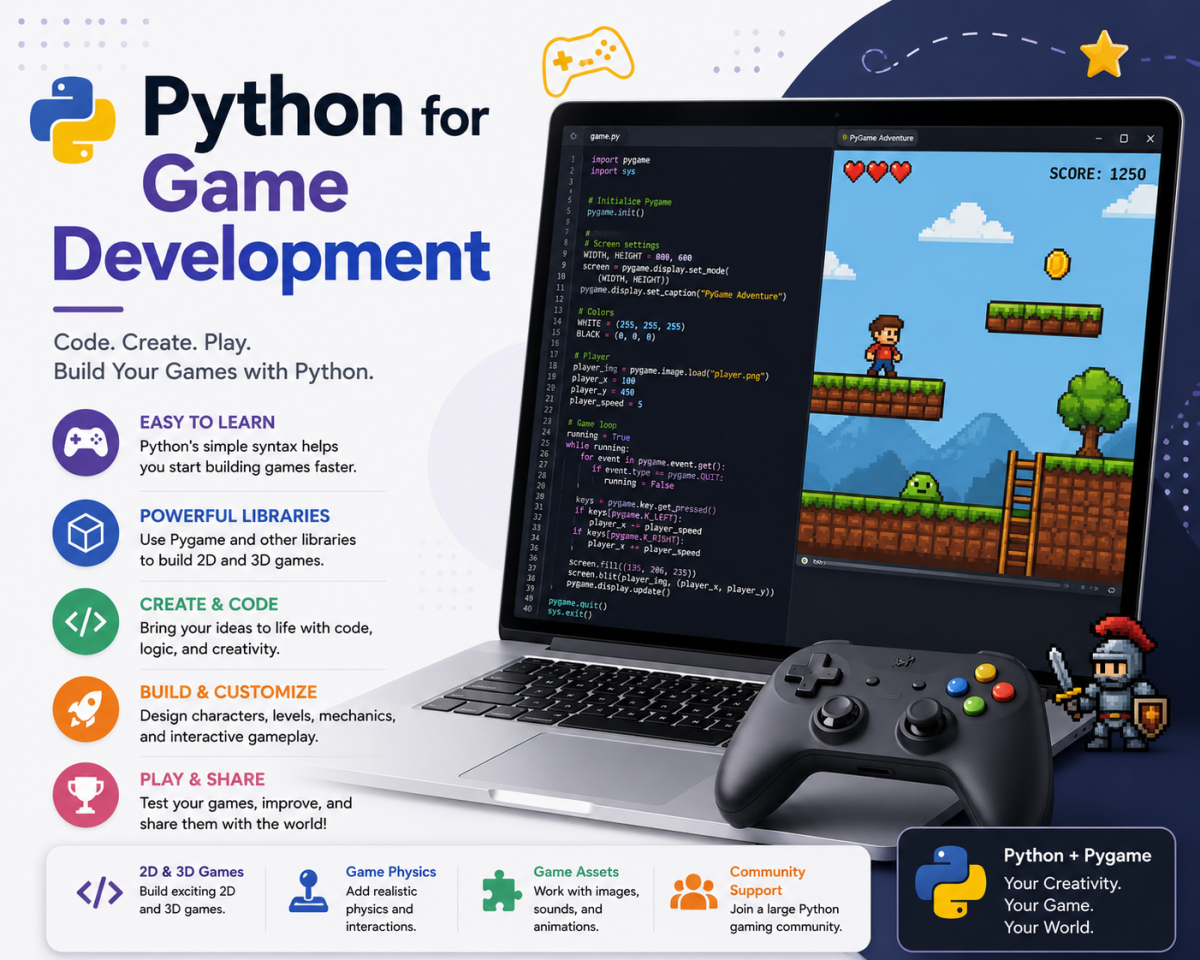
Python II · Intermediate · Project-Based
Game Development Projects with Python
Turn Python fundamentals into complete game systems. Learn how real games organize state, player data, combat, scenes, saving, difficulty, graphics and animation—then combine those systems into a playable final game.
4 modules · 8 instructional units · 4 module project capstones · 1 final capstone · Python 3 + Pygame · AI Tutor · CiAI certificate
Original price was: USD$50.00.USD$15.99Current price is: USD$15.99. /month
Self-paced online learning for students who already know core Python fundamentals.
Intermediate level · Requires prior Python foundations · Build, test, debug and connect real game systems
Think Like a Game Developer
Learn game loops, state management, modular structure and system-level planning.
Build RPG Systems
Create player stats, inventory, levels, combat, shops, maps and progression.
Add Professional Features
Save progress with JSON, add autosave logic and design scalable difficulty.
Move Into Pygame
Create windows, movement, collision detection, sprites and animation.
From Python Fundamentals to Full Game Construction
This course assumes students already know variables, data types, conditions, loops, functions, strings and basic logic. Instead of re-teaching syntax, it uses those skills as building blocks for game architecture and larger connected programs.
The course emphasis
Plan the system → build one game mechanic → test it → connect it to earlier systems → debug in small pieces → assemble a complete game.
Students arrive knowing
- Variables and data types
- Conditions and Boolean logic
- for and while loops
- Functions and reusable code
- Strings and basic data structures
- Basic program logic
Students learn to build
- Game loops and game states
- Inventories, player stats and levels
- Turn-based RPG combat
- Menus, shops and world navigation
- Persistent save systems
- Visual Pygame movement and animation
Four Modules — One Connected Game Development Journey
Module 1
Designing the Core of a Game
Game architecture, state, player data, inventories, stats, XP and levels.
Module 2
Building Gameplay Systems
RPG combat, enemy logic, scenes, menus, shops, maps and navigation.
Module 3
Creating Professional Game Features
JSON save/load, autosave, game balancing, difficulty scaling and progression.
Module 4
Bringing Games to Life
Pygame, visual movement, collision detection, sprites and animation.
Game Development Projects with Python — 8 Units
Each unit develops one game system and a practical build. Expand each unit to see how the course progresses toward larger connected games.
Learn how real games are structured using a game loop, game states such as menu/playing/game over, and modular program organization.
Unit Build: Game Hub SystemUse lists and dictionaries to organize player health, strength, XP, levels and inventory, then connect those values to progression logic.
Unit Build: Character Progression SystemBuild turn-based combat with player/enemy stats, damage formulas, repeated battle turns, simple enemy logic and randomness.
Unit Build: Turn-Based Battle SimulatorUse scene-switching logic to move between menus, shops, maps, battles and other locations while updating shared player data.
Unit Build: Game World Navigation SystemSave player data, inventory, gold, level and other game state to JSON, then restore the saved game and introduce autosave logic.
Unit Build: Save-and-Load SystemUse difficulty multipliers, enemy progression, XP curves and balanced item/stat values so challenge changes in a controlled way.
Unit Build: Dynamic Difficulty ManagerSet up Pygame, create a game window, draw shapes, handle player movement, detect collisions and understand frame-based game loops.
Unit Build: Playable Pygame Mini-GameCreate shape-based sprites, move them across the screen and add simple animation and visual effects without requiring external image assets.
Unit Build: Animated Character System4 Module Project Capstones
Each module is followed by a project capstone that consolidates the systems taught in that stage. These four module capstones are separate from the final course capstone.
Bring together game architecture, player state, inventories, stats, XP and levels into one connected game foundation.
Connect RPG combat with scenes, menus, shops, maps and navigation so several gameplay systems share the same game state.
Combine persistent JSON save/load with difficulty and balancing systems so a game can remember progress and adapt challenge.
Combine Pygame movement, collision handling, shape-based sprites and animation into a playable visual game system.
Final Course Capstone — Build a Complete Playable Game
After the four module project capstones, students plan, build, debug, polish and present a complete game that brings together systems developed across the course.
Entire Course Integration
Plan, Build & Present Your Final Game
The final capstone shifts from following isolated exercises to making game-design decisions. Students select a game direction, organize the systems they need, test in small pieces, debug problems and present a finished playable result.
4modules integrated
8instructional units applied
1complete playable game
Portfolioproject students can demonstrate
- Plan the game before coding
- Use a structured game loop
- Manage menus and gameplay states
- Model player and game data
- Use combat or interaction systems
- Add progression or difficulty logic
- Save/load game state where appropriate
- Use Pygame graphics and movement where appropriate
- Debug and polish the full game
- Present a finished playable project
Final-project directions supported in the course materials: 2D dodge game, mini platformer, top-down adventure, turn-based RPG, or shop-and-exploration game.
Continue Your Python Path
Next Course 1
Python III: Game Builder
Continue from game-development systems into larger integrated game-building projects and more advanced gameplay mechanics.
Continue to Python III: Game Builder →
Next Course 2
Data Skills with Python
Broaden your Python experience by applying programming skills to structured data, analysis and practical data-focused work.
Continue to Data Skills with Python →Course Details
CoursePython II: Game Development Projects with Python
PathwayPathway 1 · Course 2
LevelIntermediate
Format100% self-paced, online
Modules4
Instructional units8
Module project capstones4 — one per module
Final capstone1 complete playable game
Core toolsPython 3 · JSON · Pygame
AI TutorIncluded
CertificateCanadian Institute of Artificial Intelligence (CiAI)
Frequently Asked Questions
This is an intermediate course. Students should already understand variables, data types, conditions, loops, functions, strings and basic logic before starting.
The course contains 8 instructional units, 4 module project capstones—one after each module—and 1 final course capstone.
Students plan, build, debug, polish and present a complete playable game. The course materials suggest directions such as a 2D dodge game, mini platformer, top-down adventure, turn-based RPG, or shop-and-exploration game.
Yes. Students learn Pygame setup, game windows, drawing, player movement, collision detection, frame-based loops, shape-based sprites and animation.
Yes. Students receive AI-supported explanations, hints, debugging guidance and help understanding how their game-development code works.
The certificate of completion is issued by the Canadian Institute of Artificial Intelligence (CiAI).
Continue with Python III: Game Builder, followed by Data Skills with Python.
Meet the Creator of the Course
Learn from an experienced AI and machine-learning scholar who also builds applied technology solutions.

Dr. Mark Lokanan
Professor at Royal Roads University · Senior Machine Learning Engineer at Vedia · Senior Machine Learning & AI Scholar
Dr. Mark Lokanan is a Professor at Royal Roads University and Senior Machine Learning Engineer at Vedia. His work spans machine learning, artificial intelligence, data science, analytics and applied technology. His teaching focuses on making coding, data and AI practical and understandable through structured projects that show learners how individual pieces of code connect into complete systems.